Writing for Fortune magazine, David Morris examines the influence of the Anti-Agenda 21 movement, especially one of the movement's figureheads, Rosa Koire, who wrote the book "Behind the Green Mask: U.N. Agenda 21."


Morris's coverage of the Anti-Agenda 21 movement is fairly diplomatic, letting the movement's leaders' words speak for themselves and putting the words like "conspiracy theorists" in the mouths of others.
For an example of Morris's restraint:
"Those who have faced these activists are often mystified by their detection of international influence on local planning, and intensely frustrated by their tone and tactics."
And:
"Agenda 21’s opponents assert direct lines of connection among agencies and governments, with the United Nations at the center. This is what makes talking to Rosa Koire both beguiling and confounding. She’s cogent and detailed as she critiques the elite international influence that has promoted sustainable development through commissions, councils, and nonprofits."
But the irrationality of many of the viewpoints of the movement, as well as the destructive nature of the movement's tactics, is also implied:
- Koire claims that the master plan behind Agenda 21 is 'to restrict your choices, limit your funds, narrow your freedoms, and take away your voice.' She describes bicycle advocacy groups, 'often dominated by testosterone-laden zealots,' as “the 'shock troops' for this plan."
- "Rosa Koire defends the tactics that have limited dialogue. 'These public meetings are truly designed to stop people from having an opportunity for input. There are times when the only way to block a thing is to . . . really shut down a meeting.'"
The stakes of the Agenda 21 opposition are fair from resolved. Pending controversies include a suit by Koire against Plan Bay Area, "a set of development guidelines including expanded public transportation and a denser urban core." Moreover, the United Nations is currently considering a new set of sustainable development guidelines, but many nations, including the United States, are balking at the idea of supporting a potentially divisive international platform.
Read the full story: Agenda 21: Global conspiracy or climate savior?
United Nations Taking First Steps Toward the New Urban Agenda
Some of the big work left undone by the Habitat III summit in finalizing the New Urban Agenda in December is now moving forward. The future of the New Urban Agenda and UN-Habitat can now start to take shape.
Environmentalists Settle Lawsuit on Plan Bay Area
Two down, two to go. Rarely has a regional transportation/land use plan been sued by so many diverse groups. Environmentalists settled with Bay Area regional planning agencies with assurances that the 2017 plan will better account for GHG reductions.
How Agenda 21 Trumps Planning
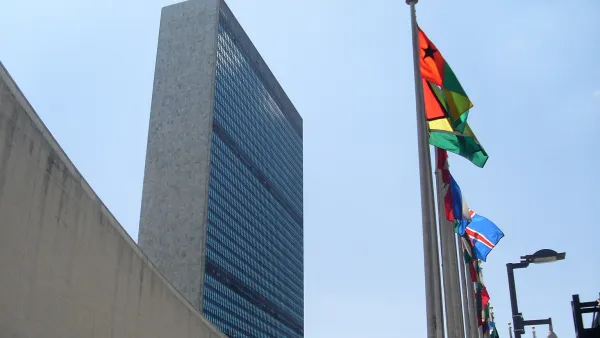
Agenda 21, a nonbinding United Nations resolution signed in 1992 by 170 world leaders, was developed to encourage "sustainable development." Now it’s a political talking point that kills planning efforts all over the country.

Planetizen Federal Action Tracker
A weekly monitor of how Trump’s orders and actions are impacting planners and planning in America.

California plans to bury El Niño’s downpour
If the state plays its cards right, it may be able to store a billion acre-feet of El Niño’s water in aquifers.

Desperate measures: Advocates weigh draining Lake Powell to fill Colorado River
Draining the reservoir could reduce evaporation losses by a couple hundred thousand acre-feet.

Mamdani’s pied-à-terre tax survives legal challenge
A panel of judges found that the plaintiffs failed to demonstrate injury as a result of New York City's implementation of the tax.

Eastern Nebraska is running out of electricity
Data centers and electrification are straining eastern Nebraska’s grid, throttling economic development.

Seattle passes record-breaking transit services expansion
Proposition 1 will double the city’s transit tax to add 95,000 more bus trips and preserve 180,000 bus trips annually.

FREE Course: Walkable City 1: Why Walkability?
After describing his path towards focusing on walkability as the essence of good planning, Jeff Speck marches through his five principal reasons for making more walkable places.
Reinventing Malls: Planning Alchemy—Turning Gray Fields Into Gold
The course focuses on the opportunities and imperatives that shape reinvention of mall sites.

City of Rosemead
Rutgers University, Edward J. Bloustein School of Planning and Public Policy
One Hundred Miles
University of Michigan School for Environment and Sustainability (SEAS)
Hunter College, City University of New York (CUNY)
The Architects Foundation
City of Cambridge
Montrose County
The Pocatello Development Authority