Agenda 21, a nonbinding United Nations resolution signed in 1992 by 170 world leaders, was developed to encourage "sustainable development." Now it’s a political talking point that kills planning efforts all over the country.


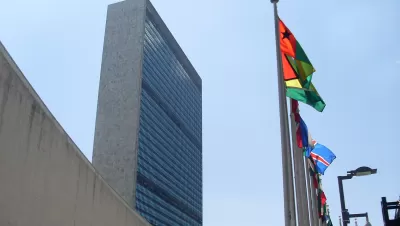
Don Terry begins this examination of Agenda 21’s influence over planning by telling the story of Horizon 2025, “a comprehensive development plan” for Baldwin County, Alabama.” The Baldwin County Commission killed the plan, prompting the mass resignation of the county’s Planning and Zoning Commission. According to Terry’s article: “The plan was killed…’on a pretext so devoid of relevance and merit as, in our opinion, to elicit only ridicule on the part of any serious knowledgeable observer.’” That pretext was Agenda 21.
Here’s how Terry sums up the impact of Agenda 21 on planning efforts around the country: “In recent years, Agenda 21 has become an effective rallying cry used by right-wing groups to beat back everything from bike paths to smart meters on home appliances. The attacks have caught city councils, planning commissions and smart-growth advocates across the country off guard, leaving them scrambling to mount a defense. Collateral damage to date includes a light rail system in Tampa, Fla., a federal ‘blueway’ program that would have protected rivers, and a road improvement project in Maine.”
Read the full story: Agenda of Fear


Planetizen Federal Action Tracker
A weekly monitor of how Trump’s orders and actions are impacting planners and planning in America.

California plans to bury El Niño’s downpour
If the state plays its cards right, it may be able to store a billion acre-feet of El Niño’s water in aquifers.

Chicago breaks ground on $3 billion megadevelopment
The new neighborhood, titled Foundry Park, will one day host 3,700 residences.

One of Denver’s busiest corridors to gain BRT
The project will span 18 miles and contain 74 bus rapid transit stations.

275,000 bus trips are at stake on Seattle's ballot
If passed, the Seattle Transit Measure would trigger a 0.3% sales tax and raise an average of $138 million per year to maintain and expand Seattle’s bus services.

Texas may pay Israeli company billions to ease water woes
Texas awarded IDE Technologies the contract for its Harbor Island project, which is slated to become the Western Hemisphere's largest desalination plant.

FREE Course: Walkable City 1: Why Walkability?
After describing his path towards focusing on walkability as the essence of good planning, Jeff Speck marches through his five principal reasons for making more walkable places.
Reinventing Malls: Planning Alchemy—Turning Gray Fields Into Gold
The course focuses on the opportunities and imperatives that shape reinvention of mall sites.


City of Rosemead
Rutgers University, Edward J. Bloustein School of Planning and Public Policy
One Hundred Miles
Hunter College, City University of New York (CUNY)
The Architects Foundation
University of Cincinnati Online
City of Cambridge
Montrose County
The Pocatello Development Authority