Transportation
Protected Bike Lanes May Receive Federal Recognition
While protected bike lanes have yet to be recognized by AASHTO, they are en route to being recognized by US DOT, writes Green Lane Project's Michael Andersen. With federal guidance, transportation engineers may be more willing to build cycle tracks.
Rising Costs Threaten to Thwart UK High-Speed Rail
Britain's grand plan to halve travel times between the country's biggest cities and expand economic growth outside London via high-speed rail is getting pushback from the very places it's meant to help.
Death By Auto: Are They Always Accidents?
Sarah Goodyear describes the greater implications of the carnage caused by a motorist intent on mowing down as many pedestrians as possible on the Venice boardwalk in L.A. on August 03. It wasn't the first time a car caused mayhem in a public space.
Study Details SFpark's Surprising Results
The preliminary results are in for America's most ambitious experiment in demand-based parking pricing. Among the surprises: the average price at the spaces participating in San Francisco's pioneering program actually declined by 1 percent.
Can Biking Build a Bridge to Transit in Birmingham?
Urban areas across the country have identified bikes as a fat-burning, congesting-decreasing, transit-supporting alternative to automobiles. And Birmingham – despite a need for all these benefits – has lagged tremendously behind.
The Danger in Transportation Fantasizing
We hear a lot about the next leap forward in transportation, whether it be Elon Musk's Hyperloop or Tel Aviv's floating pods. But in focusing on the latest fantasy, are we harming our ability to address the problems of the present?
Feds Withholding $2 Billion in Funding for CA Transit
The U.S Department of Labor is holding up the distribution of billions of dollars in transit funding destined for San Diego, Sacramento, Los Angeles and other California cities due to a new state pension law's impact on transit workers.

What's Behind the Decline in Young Drivers?
The results of a recent survey indicate the primary reasons for the steady decline in the number of young Americans getting drivers' licenses. Hint: the top reason isn't that it costs too much to own a car.
D.C. Bike Share a Victim of Its Own Success
With 174 stations in DC, and more than 200 throughout the region, Capital Bikeshare has logged almost 5 million rides since it launched in 2010. The program's immense popularity has caused some problems however, with demand often outstripping supply.
Chicago Planning Meeting Turns Against Cyclists, Walkability
This week, the Illinois DOT kicked off a set of public meetings to "redefine" Chicago's Lake Shore Drive. At the first meeting, a decidedly pro-car and anti-bicyclist sentiment crept into the comments.
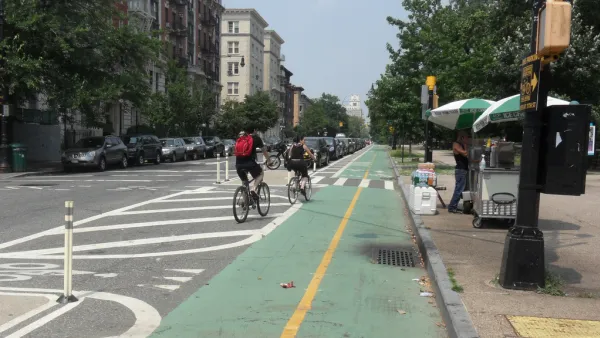
Got Protected Bike Lanes?
While Angie Schmitt doesn't ask this question in her article on the movement behind these lanes, she writes that cities without them "are being left behind". They're popular because they effectively address the #1 reason for not riding: safety
Could Chicago's Lake Shore Drive Get a Complete Street Makeover?
As the State of Illinois and City of Chicago begin envisioning the future of North Lake Shore Drive, a coalition of 15 local advocacy groups have put forth a plan to return the artery to the original vision put forth by Daniel Burnham.
New Transportation Secretary Takes Aim at Rise in Pedestrian Fatalities
At the same time that vehicular fatalities have ridden a decade-long decline in the U.S., a troubling trend has seen pedestrian fatalities increase. A $2 million U.S. DOT grant program will target 22 cities with acute pedestrian safety problems.
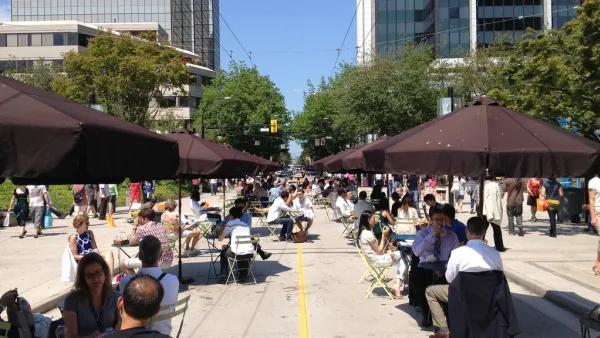
How Did Vancouver Decrease its Traffic While Growing its Population?
With its elegant skyline, walkable streets and stunning parks, Vancouver exemplifies great city-making. Add to the list of achievements the city's ability to reduce traffic by 20 to 30 percent since 2006 while growing its population by 4.5 percent.
The Positive Energy Potential of Suburban Sprawl
What if most cars were electrics, most electricity was generated locally, and new development was required to have solar? Would this paradigm make sprawl more energy sustainable than compact growth? A new paper argues yes.
Jakarta Confronts its Transit Transgression
You think your daily commute is bad? In one of the world's largest cities, a lack of citywide rapid transit means daily commutes of four hours for many Jakarta residents. Help is on the way, but conditions may get worse before they get better.
Maryland Seeks Private Investor for Transformative Transit Project
Flush with revenue from higher gas taxes, Maryland is moving ahead with plans for a 16-mile light rail line connecting the state's dense D.C. suburbs. It's seeking a private partner to help it construct and operate the planned Purple Line.
With Pedestrianization Plan, the Eternal City Looks to Ban a Modern Scourge
Mayor Ignazio Marino of Rome has banned private vehicles from Via dei Fori Imperiali, built by Benito Mussolini to link his palace in Piazza Venezia to the Colosseum. Initially open to buses and taxis, it will eventually be completely pedestrianized.
To Sustain Success, Nashville Area Must Think Regionally
Two decades of phenomenal growth have transformed Nashville into 'one of America’s hottest success stories.' In an op-ed for The Tennessean, Bill Freeman argues that for the area to continue to grow wisely it will need to embrace regional planning.
A Look at Roads Not Taken Provides Path for L.A.'s More Public-Minded Future
A new exhibition of the bold designs that were never executed in Los Angeles provides lessons for today's leaders and planners. By imagining a more public-minded path for Los Angeles, it provides the impetus for creating such a future.

FREE Course: Walkable City 1: Why Walkability?
After describing his path towards focusing on walkability as the essence of good planning, Jeff Speck marches through his five principal reasons for making more walkable places.
Reinventing Malls: Planning Alchemy—Turning Gray Fields Into Gold
The course focuses on the opportunities and imperatives that shape reinvention of mall sites.

City of Rosemead
Rutgers University, Edward J. Bloustein School of Planning and Public Policy
One Hundred Miles
University of Michigan School for Environment and Sustainability (SEAS)
Hunter College, City University of New York (CUNY)
The Architects Foundation
City of Cambridge
The Pocatello Development Authority
The Urban Renewal Agency of the City of Pocatello









