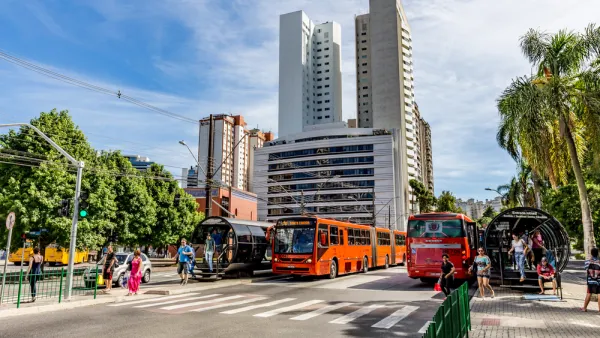
The waning popularity of its transportation system and the lack of attention to its lower-income population has put Curitiba’s “reputation as an urban planning model” on the line.


Curitiba has been known for its excellent urban planning, but the city's messy reality is drifting further from its exulted image. Flavie Halais reports that the once-celebrated Bus Rapid Transit system "has become overcrowded and expensive, pushing people into their cars." This Brazilian state capital is also faulted with ignoring its growing lower-income suburbs, leaving residents detached from "most of the planning interventions that Curitiba is known for - public parks and green spaces, pedestrian streets, preservation of the historic district."
"The misfortune of the BRT speaks to the larger failings of the city governance in Curitiba. Once praised for its impeccable urban planning and innovative interventions – the city pretty much invented the term "urban acupuncture" – Curitiba now seems to be suffering from a certain inertia."
"An estimated 10 to 15 percent of the population still lives in substandard housing, and 83 percent of the population in the metropolitan area earns a low to moderate income (less than five monthly minimum wages). Crime is high, with 4.7 murders on average each day. That's 56.8 murders per 100,000 inhabitants, a rate almost as high as New Orleans' (58 murders per 100,000 inhabitants in 2011.) These figures aren't bad by Brazilian standards. But Curitiba was supposed to be different than a typical BRIC city."
Thanks to Akemi Leung
Read the full story: Has South America's Most Sustainable City Lost Its Edge?

Jaime Lerner, One of the World's Most Influential Urbanists, Passes Away at the Age of 83
A sad day for the world of planning and urban design innovation, as Jaime Lerner, the Brazilian urbanist who created the concept of bus rapid transit as we know it today, passed away in Brazil.
Jamie Lerner Discusses BRT, "Portable Streets", and Sustainability
The Dirt interviewed Jamie Lerner, an architect, designer, and former Mayor/Governor from Brazil who is credited with introducing the world's first BRT system in Curitiba, Brazil.
Using 'Urban Acupuncture' To Begin Healing Cities
By focusing on certain "pressure points" in urban areas, a city can dramatically increase its quality of life, argues Jaime Lerner, the former mayor of Curitiba, Brazil.

Planetizen Federal Action Tracker
A weekly monitor of how Trump’s orders and actions are impacting planners and planning in America.

Amtrak, CN end decades-long dispute with eight-year agreement
The new operating agreement establishes an updated framework for the companies to work together, including processes to resolve disputes.

Northwest rail fans eager for Sept. 30 debut of Amtrak’s Airo fleet
Get ready for that new train smell and more seats. But they won’t go faster or run more frequently on the Cascades route in Washington and Oregon.

Record-breaking wildlife overpass in Colorado brings 91% reduction in animal collisions
Prior to the overpass, vehicles were hitting one deer per day on Colorado’s Interstate 25.

California lawmakers approve just 5% of much-needed LA28 transportation funding
State legislators appear just as unwilling as Trump to pay for Olympics-related transportation projects.

MTA looks to bring AI-assisted, multilingual announcement system to subways
Some of the transit agency’s audio systems haven’t been upgraded in 40 years.

FREE Course: Walkable City 1: Why Walkability?
After describing his path towards focusing on walkability as the essence of good planning, Jeff Speck marches through his five principal reasons for making more walkable places.
Reinventing Malls: Planning Alchemy—Turning Gray Fields Into Gold
The course focuses on the opportunities and imperatives that shape reinvention of mall sites.

City of Thousand Oaks
City of Wisconsin Rapids
Harvard University Graduate School of Design
The Architects Foundation
University of Cincinnati Online
The Pocatello Development Authority
The Urban Renewal Agency of the City of Pocatello