By focusing on certain "pressure points" in urban areas, a city can dramatically increase its quality of life, argues Jaime Lerner, the former mayor of Curitiba, Brazil.


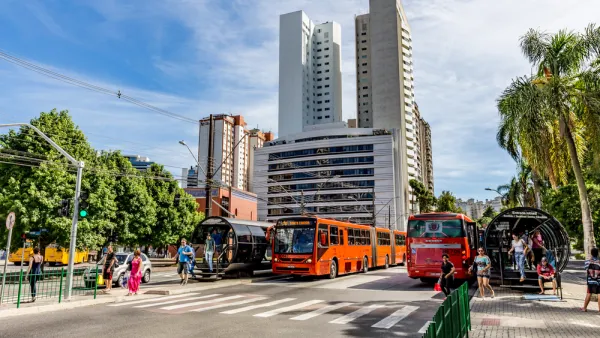
"Lerner is best known for his efforts to introduce BRT to the world, after launching the first successful rapid bus system in Curitiba in the 1970s. He now heads his own architecture and urban planning firm. 'We have to use everything we have' to make transportation, a significant emitter of greenhouse gases, more pleasant and sustainable, he told participants at Wednesday's briefing. The key to future mobility, Lerner believes, is not necessarily to get rid of cars, but to ensure that the many forms of transport currently available-bus, rail, cars, walking, and biking-are not competing for the same space."
Lerner noted that even the poorest cities can boost their standards of living by using techniques like bus rapid transit (BRT), designing multiuse buildings, and encouraging residents to live closer to their workplaces. Although many cities spend decades building underground rail systems or other costly long-term projects, 'Every city can improve its quality of life in 3 to 4 years,' Lerner asserted.
Read the full story: Curitiba's Ex-Mayor Prescribes "Urban Acupuncture"

Jaime Lerner, One of the World's Most Influential Urbanists, Passes Away at the Age of 83
A sad day for the world of planning and urban design innovation, as Jaime Lerner, the Brazilian urbanist who created the concept of bus rapid transit as we know it today, passed away in Brazil.
Curitiba Fails to Keep Up With its Vaunted Reputation
The waning popularity of its transportation system and the lack of attention to its lower-income population has put Curitiba’s “reputation as an urban planning model” on the line.
Jamie Lerner Discusses BRT, "Portable Streets", and Sustainability
The Dirt interviewed Jamie Lerner, an architect, designer, and former Mayor/Governor from Brazil who is credited with introducing the world's first BRT system in Curitiba, Brazil.

Planetizen Federal Action Tracker
A weekly monitor of how Trump’s orders and actions are impacting planners and planning in America.

Amtrak, CN end decades-long dispute with eight-year agreement
The new operating agreement establishes an updated framework for the companies to work together, including processes to resolve disputes.

Northwest rail fans eager for Sept. 30 debut of Amtrak’s Airo fleet
Get ready for that new train smell and more seats. But they won’t go faster or run more frequently on the Cascades route in Washington and Oregon.

LAX SkyLink opening delayed again, contractor won’t commit to new deadline
The project was supposed to open its doors to the public in 2023.

Caltrain may slash over one-third of its stations
If Bay Area voters reject two transit tax measures, Caltrain, BART and AC Transit will see steep service cuts.

A 'dangerous' precedent: North Carolina successfully pressures communities into voting for toll roads
Two mayors resigned from the Charlotte Regional Transportation Planning Organization after it voted in favor of the toll roads.

FREE Course: Walkable City 1: Why Walkability?
After describing his path towards focusing on walkability as the essence of good planning, Jeff Speck marches through his five principal reasons for making more walkable places.
Reinventing Malls: Planning Alchemy—Turning Gray Fields Into Gold
The course focuses on the opportunities and imperatives that shape reinvention of mall sites.

City of Thousand Oaks
City of Wisconsin Rapids
Harvard University Graduate School of Design
The Architects Foundation
University of Cincinnati Online
The Pocatello Development Authority
The Urban Renewal Agency of the City of Pocatello