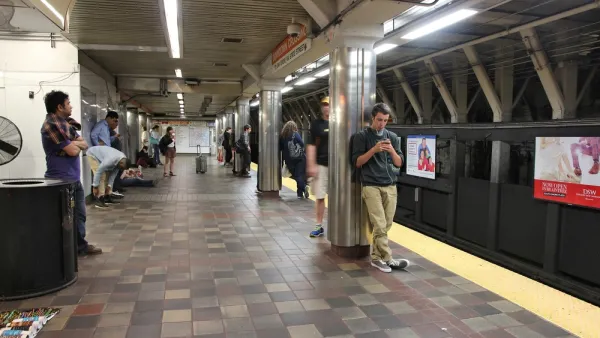
A new report from the Urban Land Institute concludes that Boston's subways could become overwhelmed by widespread congestion by the end of the decade without investment in more subway cars, better power and signal systems, reports Eric Moskowitz.


Already burdened by the highest debt obligations of any transit agency in the nation, the MBTA got news this week is likely didn't want to hear. "Surging T [subway] ridership and booming construction around transit stations, the study from the Urban Land Institute found, are poised to overwhelm the MBTA, potentially limiting future development and slowing the regional economy," warns Moskowitz.
"Congestion relief has long been a priority for highway spending; it is past time to recognize that addressing congestion is equally important for the transit system,'' wrote lead author Stephanie Pollack, associate director of Northeastern University's Dukakis Center for Urban and Regional Policy.
Accompanied by a companion report from the Metropolitan Area Planning Council that analyzed the development potential around every rapid transit and commuter rail station, "The reports are meant to reframe the debate over whether to spend scarce infrastructure dollars extending the T to new communities or repairing the aging system."
"The MBTA has a repair and replacement backlog exceeding $3 billion that grows faster than it can afford to cross old problems off the list."
Read the full story: Surging MBTA ridership could overwhelm system, report warns
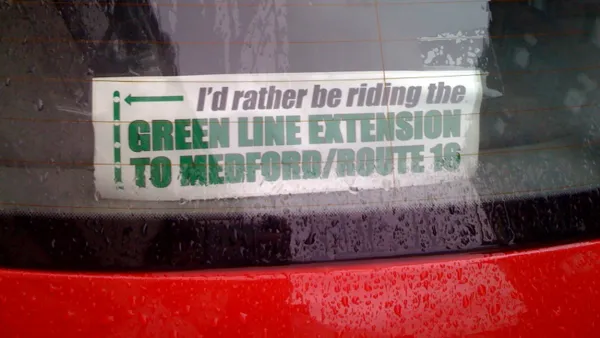
MBTA's Green Line Extension Moving Forward Again
A revised plan to extend the MBTA's Green Line light rail line into Somerville and Medford required approval from the state (approved last May) and the Federal Transit Authority (approved this week).

New Look MBTA Trains Debut in Boston
Boston residents got their first look earlier this week at the new trains that will grace the T tracks in 2019.
Bridj Wants to Offer Late Night Transit Service in Boston
A proposal by on demand bus and shuttle company Bridj would fill a gap in late night service in the Boston area.

Planetizen Federal Action Tracker
A weekly monitor of how Trump’s orders and actions are impacting planners and planning in America.

California plans to bury El Niño’s downpour
If the state plays its cards right, it may be able to store a billion acre-feet of El Niño’s water in aquifers.

Desperate measures: Advocates weigh draining Lake Powell to fill Colorado River
Draining the reservoir could reduce evaporation losses by a couple hundred thousand acre-feet.

Los Angeles just elected an urban planner as its mayor
Transportation analysts are optimistic that Raman will be more aggressive in addressing transit issues than Bass.

Mamdani’s pied-à-terre tax survives legal challenge
A panel of judges found that the plaintiffs failed to demonstrate injury as a result of New York City's implementation of the tax.

Eastern Nebraska is running out of electricity
Data centers and electrification are straining eastern Nebraska’s grid, throttling economic development.

FREE Course: Walkable City 1: Why Walkability?
After describing his path towards focusing on walkability as the essence of good planning, Jeff Speck marches through his five principal reasons for making more walkable places.
Reinventing Malls: Planning Alchemy—Turning Gray Fields Into Gold
The course focuses on the opportunities and imperatives that shape reinvention of mall sites.

City of Rosemead
Rutgers University, Edward J. Bloustein School of Planning and Public Policy
One Hundred Miles
University of Michigan School for Environment and Sustainability (SEAS)
Hunter College, City University of New York (CUNY)
The Architects Foundation
City of Cambridge
Montrose County
The Pocatello Development Authority