With Milwaukee's planned streetcar system a focus of campaign attacks by recalled governor Scott Walker on his Democratic challenger, and current mayor, Tom Barrett, Matt Dellinger asks if Walker's victory means the end of the line for the train.


With Republican governors across the country derailing rail projects left and right, Dellinger investigates whether Walker's enmity for the "$100 [sic] Boondoggle" Milwaukee streetcar system, scheduled for completion in Fall 2014, might put the line in the crosshairs as well.
Pointing to a thorough piece the Milwaukee Journal-Sentinel ran last year, Dellinger says there's reason to believe, "Walker might be powerless to stop the streetcar plan, even if he wanted to do so."
According to the article by , "A 10-year-old civil rights settlement...prohibits the state from blocking the streetcar project,
according to a top federal transportation official and an attorney
involved in the settlement. Faced with allegations that it was discriminating against urban
minorities by favoring freeways over light rail, the state agreed in
November 2000 to cooperate with the Milwaukee Connector study and to
incorporate its recommendations into the state's long-term
transportation plans. That study eventually spawned the streetcar."
Isn't it ironic then that John Norquist, who was mayor of Milwaukee at the time of the agreement, believes that transit has returned as a wedge social issue. "This last election Walker ran against the city, tried to wrap the fear
about the big city around Barrett's neck," Norquist observed. "It's all
very hardcore. They treat transit like it's a welfare queen sashaying
down a welfare promenade."
Read the full story: Will Walker’s Wisconsin Win Mean No Milwaukee Streetcar?
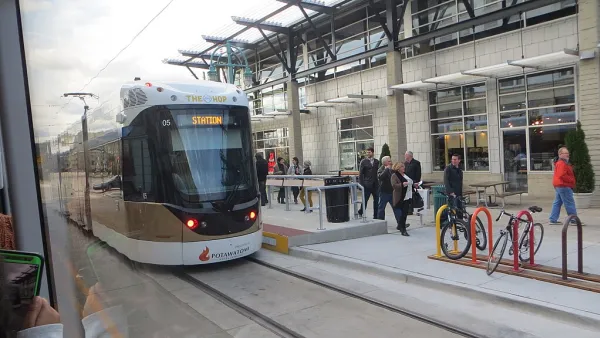
As Local Pols Call for Defunding, Milwaukee Streetcar Breaks Post-Pandemic Ridership Record
The free ‘The Hop’ streetcar has served over 3.2 million riders since it launched in late 2018.

'The Hop' Streetcar Opens to the Public Today in Milwaukee
The Hop will deliver new transit service on the east side of downtown Milwaukee. The Hop comes also serves big development expectations from local officials.
Norquist's Legacy
John Norquist is today the president of CNU, but from 1988-94 he was Mayor of Milwaukee. His legacy is apparent today in the city, says blogger Urban Engagement.

Planetizen Federal Action Tracker
A weekly monitor of how Trump’s orders and actions are impacting planners and planning in America.

California plans to bury El Niño’s downpour
If the state plays its cards right, it may be able to store a billion acre-feet of El Niño’s water in aquifers.

Desperate measures: Advocates weigh draining Lake Powell to fill Colorado River
Draining the reservoir could reduce evaporation losses by a couple hundred thousand acre-feet.

US buildings threatened, destroyed by fires set to triple by 2060
Researchers found a high fire risk for socioeconomically vulnerable neighborhoods in the American West.

LA residents may be allowed to paint their own crosswalks
Councilwoman Katy Yaroslavsky put out a motion instructing the Los Angeles Department of Public Transportation to study the feasibility of allowing volunteers to paint crosswalks.

Dallas moves to overhaul its zoning code
The city's zoning reform will allow more multi-family and mixed-use developments.

FREE Course: Walkable City 1: Why Walkability?
After describing his path towards focusing on walkability as the essence of good planning, Jeff Speck marches through his five principal reasons for making more walkable places.
Reinventing Malls: Planning Alchemy—Turning Gray Fields Into Gold
The course focuses on the opportunities and imperatives that shape reinvention of mall sites.

City of Rosemead
Rutgers University, Edward J. Bloustein School of Planning and Public Policy
One Hundred Miles
Hunter College, City University of New York (CUNY)
The Architects Foundation
University of Cincinnati Online
City of Cambridge
Montrose County
The Pocatello Development Authority