More like less-bike.


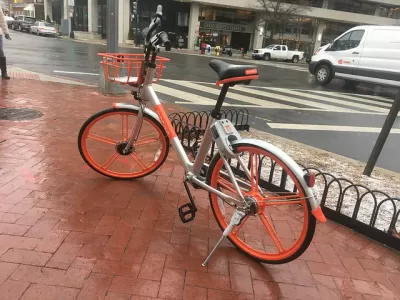
Ofo had just announced it was leaving D.C. when Mobike announced it would also be leaving the market last Wednesday. "Both companies operate millions of bikes in China and Europe, but in the United States, they have encountered regulatory challenges that they say have impeded their growth," Luz Lazo writes for The Washington Post. Mobike officials say they were not allowed enough bikes to effectively serve the area they were hoping to cover. Dockless bike share only works when riders know they will be able to find bikes when they need them, they argue.
This is not the end for the company, which says they are expanding in other markets. "Mobike staff are picking up any bikes left in D.C. streets this week and relocating them to other markets. Mobike is still operating in San Diego, Charlotte and the Houston suburbs.
FULL STORY: Mobike becomes second dockless bike operator to pull out of D.C.


People of Color in D.C. Prefer Dockless Bike Share
A new study confirms that dockless bike share has proven more successful in reaching a more diverse population in D.C. than the more traditional bike share system, Capital Bikshare.
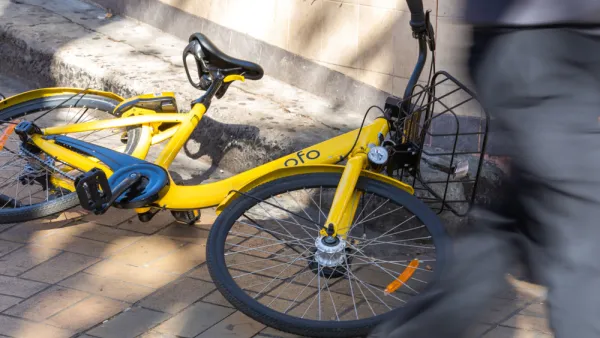
There's Little ofo Left to Share
Bike share company ofo's U.S. presence shrinks to a fraction of its former self, slashing its headcount and ending service in all but three U.S. cities.
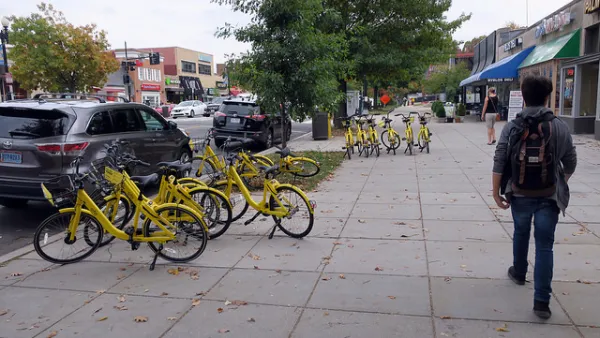
Dockless Scooters and Bike Share Meet Mixed Receptions
Milwaukee is poised to start a Scooter share pilot. Meanwhile, a “lock to” requirement for bikes in Chicago may stop companies like ofo and Lime from keeping a foothold in that city.

The state-sanctioned urbicide of Austin
People don’t kill cities. Freeways do.

US to reduce Colorado River water deliveries to Mexico
A new Colorado Treaty amendment reduces Mexico’s Colorado River water allocation by 250,000 acre feet.

New Jersey’s second-largest city bans standalone data centers
Jersey City will continue to allow co-location facilities, such as those meant for research institutions that store their own data.

Amtrak not solely to blame for New Jersey commuter rail's unreliability, report finds
A new study from the Garden State Initiative found that NJ Transit’s budget grew 20% across a 4 year period, but reliability declined significantly over the same period.

EPA erases limits on planet-warming pollution from power plants
Under Monday’s plan, power plants would still have some limits on how much mercury, arsenic and other contaminants they can emit.

Phoenix announces new on-demand transit service, more frequent RAPID buses
Both new services will launch in October, and are part of Phoenix's Project Effective Access Solutions for Easing Congestion.

FREE Course: Walkable City 1: Why Walkability?
After describing his path towards focusing on walkability as the essence of good planning, Jeff Speck marches through his five principal reasons for making more walkable places.
Reinventing Malls: Planning Alchemy—Turning Gray Fields Into Gold
The course focuses on the opportunities and imperatives that shape reinvention of mall sites.

Eagle County Government
Harvard University Graduate School of Design
Nashville Planning Department
The Architects Foundation
University of Cincinnati Online
The Pocatello Development Authority
The Urban Renewal Agency of the City of Pocatello
Journal of the American Planning Association