Milwaukee is poised to start a Scooter share pilot. Meanwhile, a “lock to” requirement for bikes in Chicago may stop companies like ofo and Lime from keeping a foothold in that city.


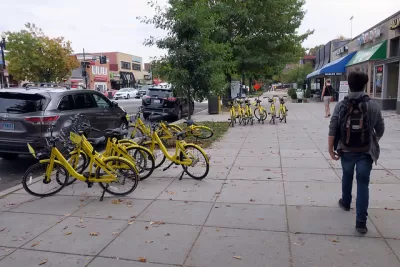
Bike and scooter share regulations continue to evolve around the United States.
Indianapolis is considering allowing pilot programs for scooters and dockless bike shares, the city had previously not allowed either. "Elsewhere in the Midwest, dockless scooters have landed in Milwaukee, with Bird dropping off about 60 scooters in one neighborhood, Urban Milwaukee reports. The outlet also reports that Lime is in discussions with the city to launch," Rachel Kauffman reports for Next City.
Meanwhile in Chicago, bikes must have "lock to" ability or the city limits fleet sizes. The city wishes to restrict bikes with wheel locks in favor of bikes that can be locked to posts and bike racks. Lime and ofo, two companies that provide dockless share bikes with wheel lock mechanisms, have protested that the regulations are unique to Chicago and unnecessary.
Read the full story: Dockless Scooters and Bike-Shares Launch in New Cities, Spark Conflict in Others

Bike-Share Spreads Across Sprawling Midwest
Bike-share is continuing its march towards world domination, with seemingly every large Midwestern American city now jumping on the bike lending bandwagon, reports Angie Schmitt.

Chicago Sees Record Shared Bike, Scooter Use
Riders took over 11 million bike share and scooter trips in 2024.

Dockless Bike Share Arrives in Staten Island
Lime and Jump were allowed to bring 300 bikes to the borough, where bike share became available in late July.

Planetizen Federal Action Tracker
A weekly monitor of how Trump’s orders and actions are impacting planners and planning in America.

California plans to bury El Niño’s downpour
If the state plays its cards right, it may be able to store a billion acre-feet of El Niño’s water in aquifers.

Chicago breaks ground on $3 billion megadevelopment
The new neighborhood, titled Foundry Park, will one day host 3,700 residences.

California High-Speed Rail Authority CEO resigns after $600,000 scandal
Under Ian Choudri, the authority used taxpayer dollars to fund first class flights and trips to nightclubs.

Want to study the Missouri River? Soon, you may need unanimous approval from 10 states
Legislation would require 10 governors’ permission to study or build projects moving water outside the basin.

Desperate measures: Advocates weigh draining Lake Powell to fill Colorado River
Draining the reservoir could reduce evaporation losses by a couple hundred thousand acre-feet.

FREE Course: Walkable City 1: Why Walkability?
After describing his path towards focusing on walkability as the essence of good planning, Jeff Speck marches through his five principal reasons for making more walkable places.
Reinventing Malls: Planning Alchemy—Turning Gray Fields Into Gold
The course focuses on the opportunities and imperatives that shape reinvention of mall sites.

City of Rosemead
Rutgers University, Edward J. Bloustein School of Planning and Public Policy
One Hundred Miles
Hunter College, City University of New York (CUNY)
The Architects Foundation
University of Cincinnati Online
City of Cambridge
Montrose County
The Pocatello Development Authority