Brisbane, a city of about 4,700 on the southern border of San Francisco, will vote on a controversial ballot measure in November to approve or reject a mixed-use development including up to 2,200 residential units on a 660-acre vacant brownfield.


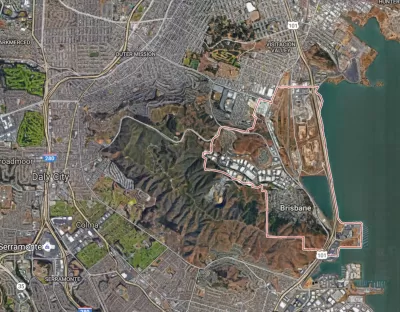
The project, known as Brisbane Baylands, has received national attention as it illustrates California's housing crisis, exposing the conflict between suburban communities resisting new housing construction and meeting the Bay Area's housing demand. The site is directly served by the San Francisco-to-San Jose commuter rail line, enabling a 2-stop, 12-minute trip to the San Francisco Caltrain terminal.
"The Brisbane City Council agreed Thursday, July 19, to call a fall election seeking voter approval for construction of up to 2,200 residential units and 7 million square feet of commercial space on the 684-acre [former] landfill abutting the Bayshore," reports Austin Walsh for the San Mateo Daily Journal.
The proposed project is roughly twice the size of Brisbane, where there are currently 2,050 housing units and approximately 5.8 million square feet of commercial space.
The decision marks the most significant step forward in more than a decade for the project proposed by Universal Paragon Corporation, as residents, officials and others have spent years deliberating over whether the site adjacent to the county’s northern border is suitable for development.
The city council voted unanimously on three measures: certifying the Environmental Impact Report, approving 1,800 to 2,200 housing units, and placing the Baylands General Plan Amendment [pdf] on the November 6 ballot. A fourth measure, dealing with commercial development, was not unanimous. From the city's project update:
Include up to 7 million square feet of commercial (Councilmember O’Connell stated she was more comfortable with 4.5 million square feet and thus dissented in her vote). Other Councilmembers expressed how they believed that 7 million sq. ft. would allow for the City to have the most amount of future flexibility, amenities, and financial benefit, as well as be best able to assist with the regional jobs-housing imbalance.
What happens if voters reject project in November?
This may have been the most interesting part of Walsh's report because there's a good likelihood this may be the result and the uncertainty that would follow.
Failure at the ballot box would invite more uncertainty, as officials acknowledge the mounting pressure placed on Brisbane to help build an adequate amount of housing to accommodate the regional imbalance of available jobs.
To date, the largest squeeze on Brisbane was posed last year by draft legislation from state Sen. Jerry Hill, D-San Mateo, aiming to push forward housing at the site. The bill was not formally introduced due to local officials’ willingness to consider the development proposal during a series of public hearings...
Additional reading on Thursday's vote:
-
"Decision day arrives for Brisbane Baylands," also by Austin Walsh for The Daily Journal, July 19.
-
"Brisbane faces ballot vote on Baylands housing," Curbed SF, July 16.
FULL STORY: Baylands plan heads to vote

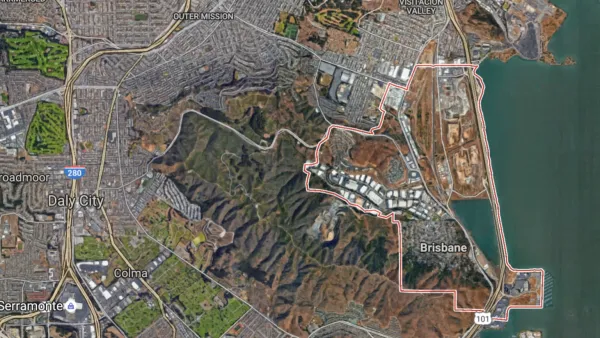
Opposition to Bay Area Housing Exposed
A 660-acre Bay Area brownfield served by commuter and light rail is the latest battleground between suburban communities intent on preserving open space and quality of life and meeting the Bay Area's unmet housing demand.
Winners and Losers of the California Primary
With national media focused on individual candidates, propositions that dealt with park and water bonds, transportation spending, cap-and-trade, and rainwater may have been overlooked. Plus, a measure to increase bridge tolls in the Bay Area.
Three Transportation Ballot Measures Could Be Headed to Bay Area Voters Next Year
The California Legislature approved bills to allow voters to decide on hiking sales taxes and tolls for regional transportation. Gov. Jerry Brown already signed a bill to allow San Mateo County voters to hike sales taxes for transportation.

Planetizen Federal Action Tracker
A weekly monitor of how Trump’s orders and actions are impacting planners and planning in America.

The state-sanctioned urbicide of Austin
People don’t kill cities. Freeways do.

US to reduce Colorado River water deliveries to Mexico
A new Colorado Treaty amendment reduces Mexico’s Colorado River water allocation by 250,000 acre feet.

5 New England states march closer to 800 megawatt wind energy project
Securing federal approval for the project may be complicated under the Trump administration, which has historically been hostile towards domestic wind power.

Baltimore to break ground on $50 million Transit Priority Project
The project will bring faster bus trips, safer streets and better bike connections to Baltimore.

Airbnb launches $250 million 'last-dollar financing' housing accelerator, makes first investment in Austin
The company will put $6.4 million towards affordable housing development in Texas’ capital.

FREE Course: Walkable City 1: Why Walkability?
After describing his path towards focusing on walkability as the essence of good planning, Jeff Speck marches through his five principal reasons for making more walkable places.
Reinventing Malls: Planning Alchemy—Turning Gray Fields Into Gold
The course focuses on the opportunities and imperatives that shape reinvention of mall sites.

Eagle County Government
Harvard University Graduate School of Design
Nashville Planning Department
The Architects Foundation
University of Cincinnati Online
The Pocatello Development Authority
The Urban Renewal Agency of the City of Pocatello
Journal of the American Planning Association