A 660-acre Bay Area brownfield served by commuter and light rail is the latest battleground between suburban communities intent on preserving open space and quality of life and meeting the Bay Area's unmet housing demand.


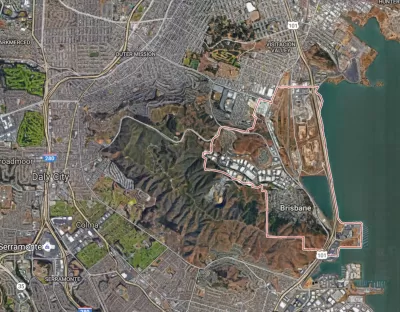
"The small community of Brisbane, Calif., just south of San Francisco, has a rare opportunity that advocates argue could help ease the region's massive housing crisis," reports Emily Badger, a reporter for Wonkblog covering urban policy.
A developer wants to clean it up and build a mixed-use project, with public parkland, that could include more than 4,000 new units of housing. And the site surrounds a stop on the regional rail line that connects workers to jobs in San Francisco and Silicon Valley.
The site, known as the Brisbane Baylands, at the northern edge of San Mateo County, is one of the largest brownfields in the Bay Area, according to the San Francisco Business Times.
"It is comprised of a former municipal landfill and former rail yard...The site's history left a legacy of contamination requiring millions of dollars and years of remediation, which is still ongoing," according to the city.
In addition to Caltrain, San Francisco MUNI and SamTrans bus routes, it's accessible to San Francisco's 'T-Third Street' light rail line that began service in 2007.
According to developer Universal Paragon Corporation, the site is "one of the largest brownfield redevelopment projects in the western United States and will serve as a model for similar projects nationwide." Project information here.
The Brisbane Baylands is the undeveloped area in below photo.

"It's exactly the kind of flat, spacious, hard-to-find place where you'd want to drop new housing in the Bay Area without displacing current residents or exacerbating traffic," adds Badger. Easy for a Washington D.C.-based urban policy reporter to write.
The housing needs "clash with a small town's reluctance to change its laid-back character," reported Aaron Kinney for The Mercury News on July 27. "The mixed-used development would triple the city's number of residential units.
On [July 28], the Planning Commission will consider whether to amend the city's general plan to allow housing on the property, which surrounds an underutilized Caltrain station and runs from downtown Brisbane to the San Francisco boundary west of Highway 101.
The commission has signaled it will vote to recommend that the City Council deny the amendment when the council takes up the issue this fall.
Sustainable development advocates are apoplectic. Matt Vander Sluis, program director for the nonprofit Greenbelt Alliance, accused the commission of "living in oblivion."
"This is unconscionable to people trying to solve a housing and transportation crunch that has turned the Bay Area into a gridlocked and gated community where local teachers can't afford to live," adds Badger.
The commission meets again on August 25. Last month's meeting was to hear from the public.
"[M]ost citizens in the audience seemed aghast at the idea of tripling the number of residential units in the city, which currently has about 2,000," reported Kinney on July 28.
In addition to housing, Universal Paragon envisions 6.5 million square feet of office, retail, and research and development space on the former industrial site, along with open space, parks and renewable energy generation. Commissioners are leaning toward a much smaller development without housing.
What's wrong here
"Part of the challenge throughout California and plenty of other communities, [Luke Tate, a special assistant to the president for economic mobility] once pointed out to me, is that we tend to make local policy — and housing policy in particular — as if the only people who matter in a community are the ones who go to bed there at night," writes Badger.
This isn't an argument for giving voting rights in Brisbane to anyone who passes through it on the train. But it raises the essential question of who we really make policy for.
Planners often try to project how a community will grow in the future, but those theoretical future residents have little voice in political fights over what happens today.
Badger continues to question the decision-making process and offers some suggestions to change it.
Hat tip: Alan Drake.
Read the full story: The people who are truly harmed when cities say no to new housing
San Francisco Suburb to Vote on Massive Project to Double Population
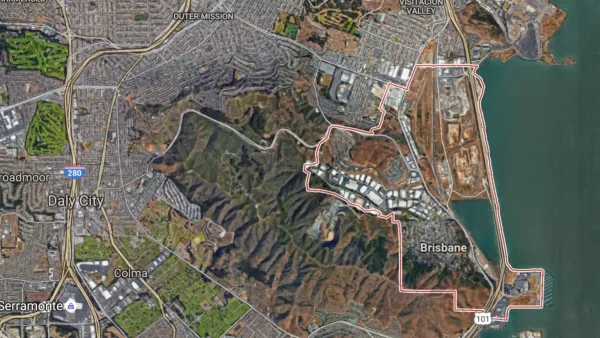
Brisbane, a city of about 4,700 on the southern border of San Francisco, will vote on a controversial ballot measure in November to approve or reject a mixed-use development including up to 2,200 residential units on a 660-acre vacant brownfield.
Housing Density a Missing Link for Emissions Reductions in California
Emissions from electricity generation are decreasing while those from transportation are increasing. If communities don't increase housing density to change travel patterns, it will only get worse, but the challenges may be insurmountable.
When Carpool Lanes Cause Mayhem
A newly widened Bay Area freeway serves as a reminder of the futility of HOV lanes. There are better ways to manage and mitigate traffic.

Planetizen Federal Action Tracker
A weekly monitor of how Trump’s orders and actions are impacting planners and planning in America.

California plans to bury El Niño’s downpour
If the state plays its cards right, it may be able to store a billion acre-feet of El Niño’s water in aquifers.

Desperate measures: Advocates weigh draining Lake Powell to fill Colorado River
Draining the reservoir could reduce evaporation losses by a couple hundred thousand acre-feet.

Mamdani’s pied-à-terre tax survives legal challenge
A panel of judges found that the plaintiffs failed to demonstrate injury as a result of New York City's implementation of the tax.

Eastern Nebraska is running out of electricity
Data centers and electrification are straining eastern Nebraska’s grid, throttling economic development.

Seattle passes record-breaking transit services expansion
Proposition 1 will double the city’s transit tax to add 95,000 more bus trips and preserve 180,000 bus trips annually.

FREE Course: Walkable City 1: Why Walkability?
After describing his path towards focusing on walkability as the essence of good planning, Jeff Speck marches through his five principal reasons for making more walkable places.
Reinventing Malls: Planning Alchemy—Turning Gray Fields Into Gold
The course focuses on the opportunities and imperatives that shape reinvention of mall sites.

City of Rosemead
Rutgers University, Edward J. Bloustein School of Planning and Public Policy
One Hundred Miles
University of Michigan School for Environment and Sustainability (SEAS)
Hunter College, City University of New York (CUNY)
The Architects Foundation
City of Cambridge
Montrose County
The Pocatello Development Authority