After failing to implement a car ban, Oslo officials are converting downtown street parking into public space.



Oslo officials made ambitious goals to cut the city's emissions by 95 percent by 2030, then a downtown car ban failed to pass. Still, officials didn't give up on cutting the significant portion of emissions that comes from private cars. "Instead of an outright car ban, Oslo has now announced a tactical-urbanism approach to limiting vehicle movement through the city center by simply removing all the parking spots from the area," Eillie Anzilotti reports for Fast Company.
The onstreet parking the city is reclaiming will be put to use in other means. "Some will be playgrounds or cultural events, or [contain] benches or bike parking—or other things you can fill the space with when you don’t have 1,200 kilograms of glass and steel," Oslo vice mayor for environment and transport Lan Marie Nguyen Berg recently said on the record for a separate article for The Guardian.
"Those plans are spelled out in more detail in the city’s outline for six pilot spaces, which include ideas for a beer garden and an 'outdoor living area' featuring different pieces of street furniture and an e-bench with wifi and charging capabilities," Anzilotti writes.
Officials hope that business and residents will benefit from the more walk-centric streets and become more enthusiastic about the move. If they don't, these changes are unlikely to stick and it will be hard for the city to hit its emission's goals.
FULL STORY: If You Can’t Ban Cars Downtown, Just Take Away The Parking Spaces

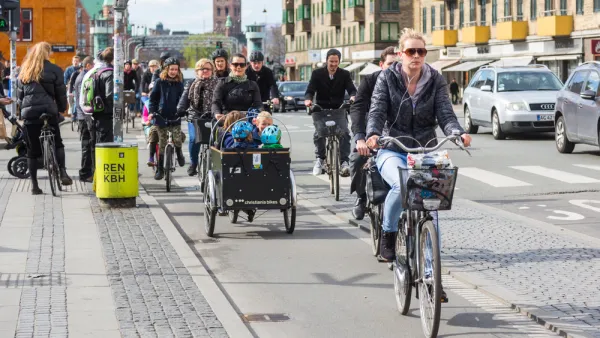
Copenhagen Update: On-Street Auto Parking Replaced by Bike Parking
Copenhagen may have already met its bicycling goal of 50 percent of modal share for commuting, but it needs to improve the share for all trips. With less funding available, the city is pursuing low cost strategies, such as auto parking removal.

Electric Vehicle Incentives: A Tale of Two Countries
While Trump wants to end the EV credit program, in part to punish GM for closing unprofitable car manufacturing plants, Norway is scaling back the generous perks that have enabled EV sales to comprise almost half on new auto sales.
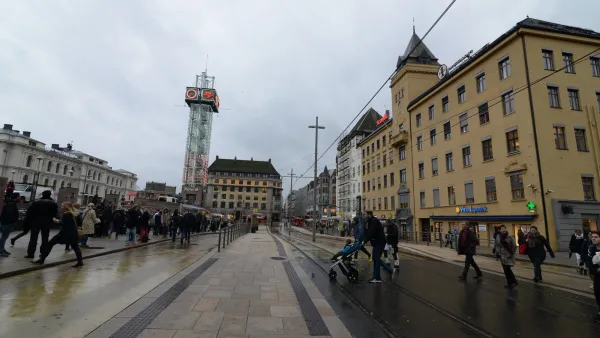
In Oslo, Streets for People, Not Cars
New measures will greatly reduce vehicle traffic in the city center as Oslo moves to put pedestrians, cyclists, and air quality before cars.

The state-sanctioned urbicide of Austin
People don’t kill cities. Freeways do.

US to reduce Colorado River water deliveries to Mexico
A new Colorado Treaty amendment reduces Mexico’s Colorado River water allocation by 250,000 acre feet.

New Jersey’s second-largest city bans standalone data centers
Jersey City will continue to allow co-location facilities, such as those meant for research institutions that store their own data.

Amtrak not solely to blame for New Jersey commuter rail's unreliability, report finds
A new study from the Garden State Initiative found that NJ Transit’s budget grew 20% across a 4 year period, but reliability declined significantly over the same period.

EPA erases limits on planet-warming pollution from power plants
Under Monday’s plan, power plants would still have some limits on how much mercury, arsenic and other contaminants they can emit.

Phoenix announces new on-demand transit service, more frequent RAPID buses
Both new services will launch in October, and are part of Phoenix's Project Effective Access Solutions for Easing Congestion.

FREE Course: Walkable City 1: Why Walkability?
After describing his path towards focusing on walkability as the essence of good planning, Jeff Speck marches through his five principal reasons for making more walkable places.
Reinventing Malls: Planning Alchemy—Turning Gray Fields Into Gold
The course focuses on the opportunities and imperatives that shape reinvention of mall sites.

Eagle County Government
Harvard University Graduate School of Design
Nashville Planning Department
The Architects Foundation
University of Cincinnati Online
The Pocatello Development Authority
The Urban Renewal Agency of the City of Pocatello
Journal of the American Planning Association