Kris Graves photographs all 77 NYPD precincts from Tottenville to Edenwald, looking to these buildings—sometimes humble, sometimes imposing—for the face and footprint of law and order in the neighborhood.


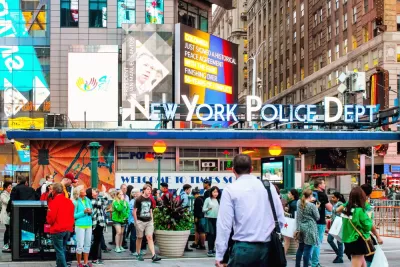
What’s the difference between a school, a library, and a police precinct? They’re all civic institutions designed to communicate their contribution to a well-functioning society. And the buildings are similar in appearance. The products of several waves of municipal construction, their locations track a growing urban population on an expanding metropolitan footprint, from dense center to leafy edges. The primary distinction might be the sea of cars parked in front of and around the police precinct, often on the sidewalk, perpendicular to the curb. The cars are the clearest sign of the exceptional powers of the building’s inhabitants, who can defy the parking dictates everyone else must live by. Beyond parking privileges, they alone can arrest people, detain them, surveil them, physically constrain them, or shoot them. For all the comparisons of schools to jails, or the myth of the oppressive silence of the library, the power of the police is unique in the city.
Read the full story: Beacon / Bunker
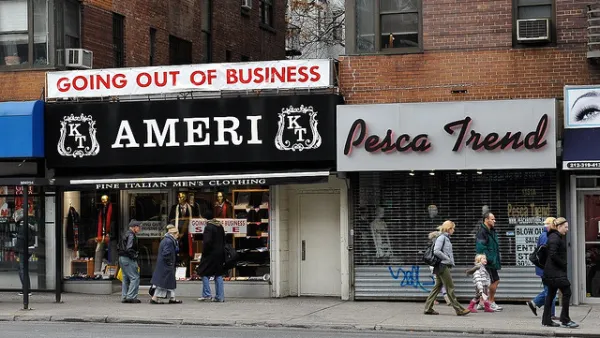
Planning Department Study Documents Storefront Vacancy in NYC Neighborhoods
A new report from the New York Department of City Planning has found that storefront vacancy may not be a one-answer citywide problem. Vacancies were found to be concentrated in certain neighborhoods, and the reasons appear to be varied.
NYC needs 700,000 new homes to resolve housing crisis, report states
The report gave every neighborhood a non-binding development target.
Manhattan Traffic Spreading to Other Boroughs
New travel patterns and an increased reliance on delivery services and ride-hailing are creating more congestion in New York's outer boroughs.

Planetizen Federal Action Tracker
A weekly monitor of how Trump’s orders and actions are impacting planners and planning in America.

California plans to bury El Niño’s downpour
If the state plays its cards right, it may be able to store a billion acre-feet of El Niño’s water in aquifers.

Desperate measures: Advocates weigh draining Lake Powell to fill Colorado River
Draining the reservoir could reduce evaporation losses by a couple hundred thousand acre-feet.

Chicago voters approve permanent festival grounds, penalty for vacant property owners
Currently, major summer and fall festivals take over public parks for weeks at a time, drawing criticism from nearby residents

NYC votes to cut outdoor dining red tape, speed up permitting
New York City also voted to allow the Department of Transportation to begin work on urgent projects before notifying elected officials.

California appears to reject Prop. 45
The proposition would have expanded the projects that qualify for a streamlined environmental review, effectively paring down the California Environmental Quality Act.

FREE Course: Walkable City 1: Why Walkability?
After describing his path towards focusing on walkability as the essence of good planning, Jeff Speck marches through his five principal reasons for making more walkable places.
Reinventing Malls: Planning Alchemy—Turning Gray Fields Into Gold
The course focuses on the opportunities and imperatives that shape reinvention of mall sites.

City of Rosemead
Rutgers University, Edward J. Bloustein School of Planning and Public Policy
One Hundred Miles
Hunter College, City University of New York (CUNY)
The Architects Foundation
University of Cincinnati Online
City of Cambridge
Montrose County
The Pocatello Development Authority