For six years, New Orleans police have been using a secret program that uses social media to locate violent criminals.



A program from Peter Theil's Palantir has been used by New Orleans cops for six years to try to predict which people are likely to have been involved in violent crimes. The program may have been controversial, but it was unknown to the public until a report published in The Verge uncovered its use. "The program, like a similar program in Chicago, pulls information from a variety of law enforcement databases and social media networks, and draws up a list of people most likely to be involved in violent crime," Tanvi Misra reports for CityLab.
If the existence of the Palantir program were public knowledge, civil rights advocates might have protested the possibility for automated discrimination. "Cities across the U.S. are adopting new surveillance technologies and algorithms without any public input or oversight," Misra writes. To address this the ACLU has been advocating for public hearings for these new technologies, so that citizens can have some say in how they are policed.
Read the full story: The Local Movement to Curb Big Brother

Learning loss and urban schools, part 2
Did test scores in progressive cities drop more post-COVID than test scores in moderate ones?

2020 Population Growth Rates for the 50 Biggest U.S. Cities
The Census Bureau released new data on May 27 that includes the first four months of the pandemic. Seattle tops the growth rate at 2.2% from July 1, 2019, to July 1, 2020, while Baltimore and San Francisco land at the bottom with -1.4%.
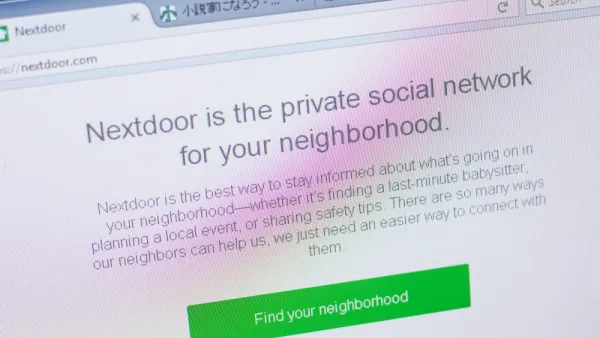
Nextdoor Getting Cozy With Local Officials
CityLab investigates the practices of company officials at Nextdoor to cultivate relationships with police and local officials.

Planetizen Federal Action Tracker
A weekly monitor of how Trump’s orders and actions are impacting planners and planning in America.

California plans to bury El Niño’s downpour
If the state plays its cards right, it may be able to store a billion acre-feet of El Niño’s water in aquifers.

Desperate measures: Advocates weigh draining Lake Powell to fill Colorado River
Draining the reservoir could reduce evaporation losses by a couple hundred thousand acre-feet.

Housing is the top priority of Seattle’s sole new councilmember
Jenks campaigned on building 1,000 new units of affordable housing.

New tax cuts may slash $1.5 billion in funding for Miami transit, public parks
Amendment 3 will save Miami-Dade homeowners $2,700 in 2028.

Arizona, Wisconsin, Pennsylvania hope to finally advance climate goals post-midterms
The three states have spent years under Republican or divided control.

FREE Course: Walkable City 1: Why Walkability?
After describing his path towards focusing on walkability as the essence of good planning, Jeff Speck marches through his five principal reasons for making more walkable places.
Reinventing Malls: Planning Alchemy—Turning Gray Fields Into Gold
The course focuses on the opportunities and imperatives that shape reinvention of mall sites.

City of Rosemead
Rutgers University, Edward J. Bloustein School of Planning and Public Policy
One Hundred Miles
University of Michigan School for Environment and Sustainability (SEAS)
Hunter College, City University of New York (CUNY)
The Architects Foundation
City of Cambridge
Montrose County
The Pocatello Development Authority