Of the city’s newest, tallest building John King writes, “[it’s] as if the creators were so busy being tasteful they forgot that big buildings can be fun."


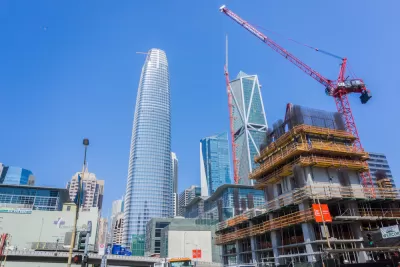
This week, the Salesforce Tower in San Francisco “quietly opened for business,” and John King, architecture critic for the San Francisco Chronicle, is only very mildly impressed.
“The 1,070-foot shaft, with its tapered form of metal and glass, is a well-tailored behemoth. Immense but understated. Overwhelming yet refined. A study in thick-walled minimalism that seems to hover more than soar.
All of which makes for a nuanced tower, conscientious and self-assured even as it reorients the skyline and redefines San Francisco’s visual image. But there’s also an air of detachment, as if the creators were so busy being tasteful they forgot that big buildings can be fun.”
In its many years under construction, the Salesforce Tower easily surpassed the height of San Francisco's now-second-tallest building, the TransAmerica Pyramid. That building was controversial in its own time but, as King previously wrote, has an iconic quality that is arguably lacking in the city's newest skyscraper.
One of a new crop of very tall buildings on the West Coast, naming rights to the Salesforce Tower—originally known as the Transbay Tower—were bought by a cloud-computing company that is a major employer in San Francisco and agreed to lease 36 of the available 61 floors.
The symbolism of a tech company looming over the entire city is not lost on observers, King has reported. And buildings of increasing heights have long been used to establish dominance in San Francisco, David Streitfeld recently wrote in The New York Times, adding of the Salesforce building, “The tower is not beautiful but is impossible to ignore.”
King reports similarly tempered comments from one of the principle architects, Cesar Pelli, who said of the tower that its was meant to be “very tall, very big, but still polite.’”
Read the full story: Salesforce Tower - underwhelming despite its size

Cloud Computing Company Will Have its Name in the Clouds above San Francisco
It is only fitting that Salesforce, whose logo is a cloud, won the naming rights to what will be the West Coast's tallest building when completed in 2017 where they will lease half the space. When the fog rolls in, that's all the workers will see!
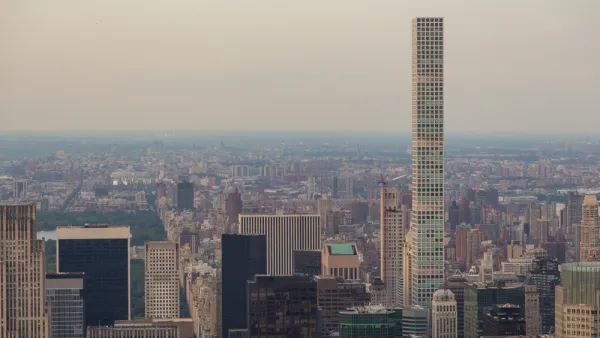
Report: Skyscrapers a Driving Factor of the Urban Heat Island Effect
As cities build upwards in an effort to create more housing and increase walkability, research shows that tall buildings intensify heat and contribute to increased carbon emissions.
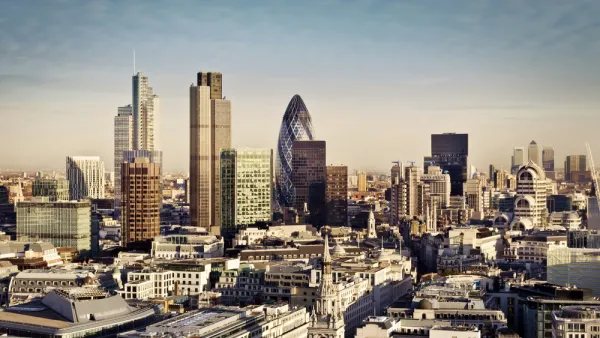
London's Tallest Buildings Currently Under Construction
In a growing London, skyscrapers seem to be popping up everywhere, We Plan London catalogs the ten tallest.

Planetizen Federal Action Tracker
A weekly monitor of how Trump’s orders and actions are impacting planners and planning in America.

The state-sanctioned urbicide of Austin
People don’t kill cities. Freeways do.

Colorado’s Largest Data Center Could Rise Next to Homes — Without a Public Hearing
The proposed campus would consume 11 times the power of Denver International Airport; as it has across the country, opposition mounts.

Nation's most wind-powered state turns to coal as data centers increase energy demand
For the first time in decades, Iowa has increased its generation of coal power.

NYC cools commuters with city's first rain garden above a bus stop
New York City officials say the plants in the rain garden can absorb 16 gallons of rainwater during heavy storms.

Brightline West’s future may rely on $6 billion federal loan
The company has until Nov. 2 to make a $400 million equity investment into its proposed high-speed rail line.

FREE Course: Walkable City 1: Why Walkability?
After describing his path towards focusing on walkability as the essence of good planning, Jeff Speck marches through his five principal reasons for making more walkable places.
Reinventing Malls: Planning Alchemy—Turning Gray Fields Into Gold
The course focuses on the opportunities and imperatives that shape reinvention of mall sites.

Greater Baltimore Committee
Eagle County Government
Harvard University Graduate School of Design
The Architects Foundation
University of Cincinnati Online
The Pocatello Development Authority
The Urban Renewal Agency of the City of Pocatello
Journal of the American Planning Association