Norman Oder asks readers to question the evidence traditionally cited in arguments that attempt to disprove displacement as a consequence of gentrification.



Two studies frequently cited to argue down connections between gentrification and displacement might be too out of date to be reliable, according to an article by Norman Oder. Oder's term for the state of two of the most frequently cited studies: "glaringly stale."
In fact, placed in a contemporary context, these two studies might do more to verify a connection between gentrification and displacement, rather than refute it, argues Oder.
The studies in question are "Gentrification and Displacement: New York City in the 1990s" [pdf] by Lance Freeman and Frank Braconi, published in the Journal of the American Planning Association in 2004, and a follow up paper by Freeman titled "Displacement Or Succession? Residential Mobility in Gentrifying Neighborhoods" and published by Urban Affairs Review in 2005.
Media outlets as widely followed as CNN, as recently as 2015, have cited the second article as reasons to doubt the displacement effects of gentrification. Yet the study, published in 2005, uses data from 1986 to 1999. Oder suggests that the conclusions of the study might no longer be valid in 2018.
FULL STORY: Oft-Quoted Studies Saying Gentrification Doesn’t Cause Displacement Are “Glaringly Stale”

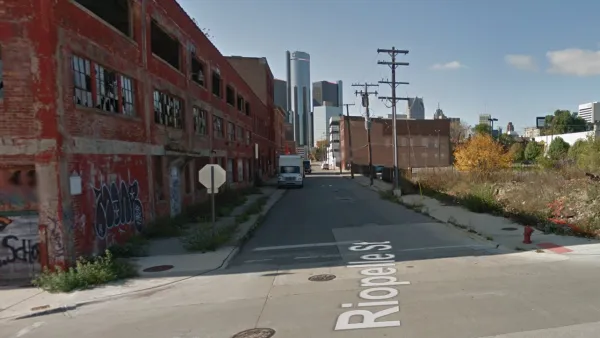
Anticipating Gentrification in Detroit
Where is gentrification most likely to occur in cities like Detroit? And how can that data guide policy? A new report provides some insight.
Study Analyses the Airbnb Effect in the New York City Housing Market
Less "sharing economy" and more normal economy for New York City in New York City, according to the findings of a recent study.
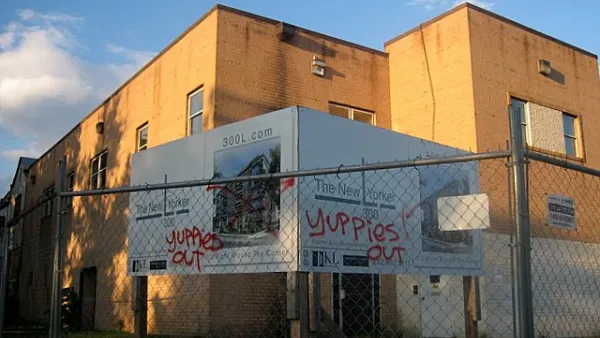
Who's Mapping Gentrification, and Where?
In these cities, data on gentrification has been compiled to build mapping tools documenting the process. The hope is to identify neighborhoods where low-income residents are at risk of displacement.

Planetizen Federal Action Tracker
A weekly monitor of how Trump’s orders and actions are impacting planners and planning in America.

The state-sanctioned urbicide of Austin
People don’t kill cities. Freeways do.

US to reduce Colorado River water deliveries to Mexico
A new Colorado Treaty amendment reduces Mexico’s Colorado River water allocation by 250,000 acre feet.

5 New England states march closer to 800 megawatt wind energy project
Securing federal approval for the project may be complicated under the Trump administration, which has historically been hostile towards domestic wind power.

Baltimore to break ground on $50 million Transit Priority Project
The project will bring faster bus trips, safer streets and better bike connections to Baltimore.

Airbnb launches $250 million 'last-dollar financing' housing accelerator, makes first investment in Austin
The company will put $6.4 million towards affordable housing development in Texas’ capital.

FREE Course: Walkable City 1: Why Walkability?
After describing his path towards focusing on walkability as the essence of good planning, Jeff Speck marches through his five principal reasons for making more walkable places.
Reinventing Malls: Planning Alchemy—Turning Gray Fields Into Gold
The course focuses on the opportunities and imperatives that shape reinvention of mall sites.

Eagle County Government
Harvard University Graduate School of Design
Nashville Planning Department
The Architects Foundation
University of Cincinnati Online
The Pocatello Development Authority
The Urban Renewal Agency of the City of Pocatello
Journal of the American Planning Association