The Federal Transit Administration has offered the Los Angeles County Metropolitan Transportation Authority a $1.35 million grant to partner with ridesharing app Via on first-last mile solutions.


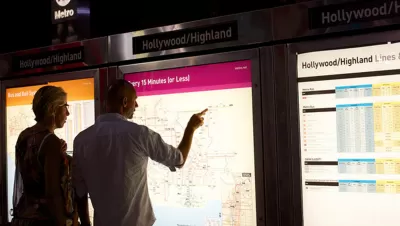
The Los Angeles County Metropolitan Transportation Authority (Metro) has partnered with ridesharing service Via on a one-year pilot program to close the first-last mile gap at select transit stations.
"Starting next summer, Metro riders will be able to book a Via to or from three major Metro stations," writes Mallory Locklear. "The fares will be subsidized by Metro and riders will be able to pay with their TAP account -- LA's public transport fare card. The project and its reduced fare rates are funded by a $1.35 million grant from the Federal Transit Administration."
The FTA is funding the pilot program with a MOD Sandbox grant. The MOD stands for mobility on demand in a program that has yet to attract a lot of attention. According to a separate post by ITS International, the Eno Center for Transportation, UCLA, and the University of Washington will be studying the Metro, Via partnership for lessons that can assist future partnerships.
Emma Huang also provides information on the new pilot project on Metro's The Source website.
FULL STORY: Los Angeles taps a shuttle service to get riders to Metro stops

L.A. Metro Jumps Into the Ridesharing Business
The Los Angeles County metropolitan Transportation Authority announced the launch of a one-year pilot program for on demand ridesharing, otherwise known as microtransit.
Poor Returns for L.A.'s Transit on Demand Pilot
Similar to microtransit on demand programs in other cities, Los Angeles' ongoing experiment is proving to be very expensive (for the public) for the benefit of very few riders.
Transit Needs Improvements Sooner Rather Than Later
The Los Angeles transit system is losing riders, but L.A. Metro has been slow to implement changes that could keep people using it.

The state-sanctioned urbicide of Austin
People don’t kill cities. Freeways do.

US to reduce Colorado River water deliveries to Mexico
A new Colorado Treaty amendment reduces Mexico’s Colorado River water allocation by 250,000 acre feet.

New Jersey’s second-largest city bans standalone data centers
Jersey City will continue to allow co-location facilities, such as those meant for research institutions that store their own data.

Amtrak not solely to blame for New Jersey commuter rail's unreliability, report finds
A new study from the Garden State Initiative found that NJ Transit’s budget grew 20% across a 4 year period, but reliability declined significantly over the same period.

EPA erases limits on planet-warming pollution from power plants
Under Monday’s plan, power plants would still have some limits on how much mercury, arsenic and other contaminants they can emit.

Phoenix announces new on-demand transit service, more frequent RAPID buses
Both new services will launch in October, and are part of Phoenix's Project Effective Access Solutions for Easing Congestion.

FREE Course: Walkable City 1: Why Walkability?
After describing his path towards focusing on walkability as the essence of good planning, Jeff Speck marches through his five principal reasons for making more walkable places.
Reinventing Malls: Planning Alchemy—Turning Gray Fields Into Gold
The course focuses on the opportunities and imperatives that shape reinvention of mall sites.

Eagle County Government
Harvard University Graduate School of Design
Nashville Planning Department
The Architects Foundation
University of Cincinnati Online
The Pocatello Development Authority
The Urban Renewal Agency of the City of Pocatello
Journal of the American Planning Association