A movement initiated by Gov. Terry McAuliffe (D-Va.) to join the East Coast carbon cap-and-trade program has accelerated with the election of his Democratic lieutenant governor, Ralph Northam, as governor. Similar news is expected from New Jersey.


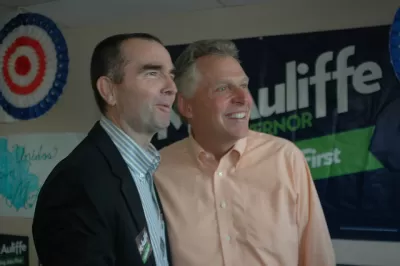
"The Democratic Party's victory on Tuesday in the governor's race appears to have cemented the move toward climate regulations, with Lt. Gov. Ralph Northam beating Republican challenger Ed Gillespie," reports John Siciliano, who covers energy and environment issues for the Washington Examiner, on Nov. 9.
Incumbent Democratic Gov. Terry McAuliffe, had initiated a process to create a greenhouse gas system after President Trump decided to scrap the Obama administration's climate change regulations this year [including the clean power plan rule].
The Virginia Department of Environmental Quality will begin presenting its draft greenhouse gas program next week to the state's pollution board for approval to create the state's first cap-and-trade program to reduce greenhouse gas emissions.
If approved, Virginia would be the 10th member of the Regional Greenhouse Gas Initiative (RGGI, but pronounced "Reggi"), the oldest, but not the largest, cap-and-trade program in the United States. Unlike its younger counterpart in California, the trading program is restricted to carbon dioxide emissions from power plants. [In California, even motorists pay about 10-12 cents more per gallon of gas since transportation fuels fell "under the cap" in 2015.]
Siciliano goes on to describe what membership in RGGI would entail, e.g., placing a 'cap' on power plant emissions and how to spend carbon auction revenues.
=================================================================================================================
Tuesday's other gubernatorial race in New Jersey, which saw Democrat Philip D. Murphy, a political newcomer, best Lt. Gov. Kim Guadagno (R), to replace two-term Republican Gov. Chris Christie, brings up the same issue. Unlike Virginia, New Jersey was one of the nine convening members of RGGI in 2003, but Christie announced in May 2011 "that the state will pull out of the region’s 'gimmicky' cap-and-trade program by the end of the year," reported Christopher Baxter of NJ Advance Media for NJ.com at the time.
Last July, Christie "vetoed A4701 [pdf] that would have required the state to return to the Regional Greenhouse Gas Initiative," reported Susan K. Livio for NJ.com.
The fifth point of candidate Murphy's five-point plan on power generation would have that state rejoin the initiative, reported NJ.com's Claude Brodesser-Akner on Apr. 27.
Should New Jersey under a Gov. Philip D. Murphy rejoin RGGI, it would not be the first time an election has resulted in a state reversing its position on RGGI. Republican Gov. Mitt Romney of Massachusetts, also a 2003 convening member, chose not to officially join RGGI in 2005. Two years later it joined thanks to the election of Democrat Deval Patrick to succeed Romney.
Hat tip to Dino Grandoni, Washington Post's Power Post, Energy 2020.
Read the full story: Virginia moving forward with cap-and-trade plan soon after Democratic win

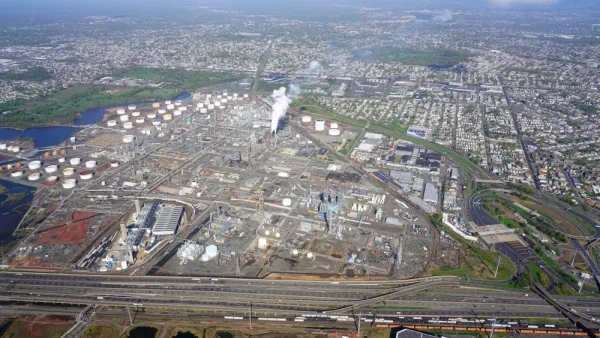
New Jersey to Price Carbon Emissions from Electricity Generation
When the N.J. Department of Environmental Protection adopted new rules for power plants on June 17, the Garden State becomes the tenth to participate in a cap-and-trade program known as the Regional Greenhouse Gas Initiative.
Republicans Block Virginia from Joining Regional Cap-and-Trade Program
The Virginia Air Pollution Control Board approved a cap-and-trade policy for utilities to join the Regional Greenhouse Gas Initiative, but Republicans added language in the state budget bill to prevent it.
State Gubernatorial Elections Have Environmental Consequences
The environment and climate change may not be top issues in the nation's hotly contested gubernatorial contests next Tuesday, but their outcomes can cause policy changes. Take North Carolina and the election of Roy Cooper, a Democrat, two years ago.

Planetizen Federal Action Tracker
A weekly monitor of how Trump’s orders and actions are impacting planners and planning in America.

Amtrak, CN end decades-long dispute with eight-year agreement
The new operating agreement establishes an updated framework for the companies to work together, including processes to resolve disputes.

Northwest rail fans eager for Sept. 30 debut of Amtrak’s Airo fleet
Get ready for that new train smell and more seats. But they won’t go faster or run more frequently on the Cascades route in Washington and Oregon.

Trump administration unlawfully slashed $7 billion in clean energy grants, judge rules
The Environmental Protection Agency ended the Solar For All program, which provided the grants, after President Donald Trump’s inauguration.

Record-breaking wildlife overpass in Colorado brings 91% reduction in animal collisions
Prior to the overpass, vehicles were hitting one deer per day on Colorado’s Interstate 25.

California lawmakers approve just 5% of much-needed LA28 transportation funding
State legislators appear just as unwilling as Trump to pay for Olympics-related transportation projects.

FREE Course: Walkable City 1: Why Walkability?
After describing his path towards focusing on walkability as the essence of good planning, Jeff Speck marches through his five principal reasons for making more walkable places.
Reinventing Malls: Planning Alchemy—Turning Gray Fields Into Gold
The course focuses on the opportunities and imperatives that shape reinvention of mall sites.

City of Thousand Oaks
City of Wisconsin Rapids
Harvard University Graduate School of Design
The Architects Foundation
University of Cincinnati Online
The Pocatello Development Authority
The Urban Renewal Agency of the City of Pocatello