Most metro systems in the United States tend to score high on accessibility, while European systems have mixed results.


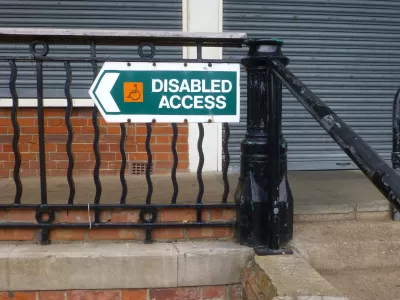
Of 270 London Tube stations, only 50 provide full accessibility to people using wheelchairs without assistance. Reporting in The Guardian, Nick Van Mead, Harvey Symons, and Aghnia Adzkia write that older systems, including the London and Paris metros, have some of the worst accessibility ratings of the systems looked at. In Paris, only nine out of the system's 303 stations were identified as fully accessible (15 stations provide elevator access, but six of those require ramps and assistance). The New York subway system also falls well short of being accessible; however other systems across the United States, including Washington, D.C., and Los Angeles, are 100 percent accessible. The article notes that the Los Angeles Metro system started operation in 1990, the same year the Americans with Disabilities Act became law.
Despite being the third busiest subway system in the US after New York and Chicago, and with large sections built in the 1970s and 80s, DC’s metro is widely lauded as one of the most accessible in the world.
All 91 stations – including the brutalist masterpieces of Harry Weese – and all trains are accessible, according to operator WMATA (the Washington Metropolitan Area Transit Authority).
Read the full story: Access denied: wheelchair metro maps versus everyone else's
Why New York's Transportation Infrastructure Costs So Much
It's been remarked upon before. Infrastructure in New York City is a cost nightmare compared to other global cities. Accountability is lacking, Josh Barro writes, but MTA also suffers from an "institutional lack of power."

Learning loss and urban schools, part 2
Did test scores in progressive cities drop more post-COVID than test scores in moderate ones?
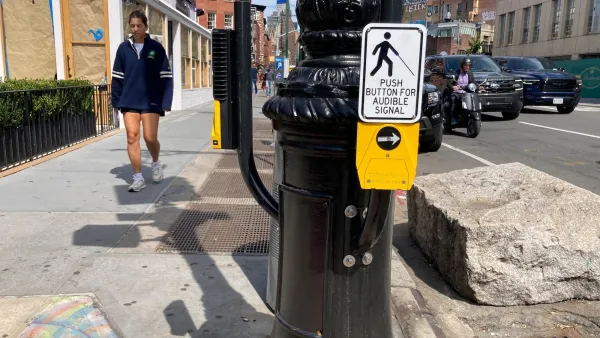
90% of NYC Intersections Lack Audible Crossing Signals for Blind Pedestrians
People with vision impairments rely on a complex network of tactile and audible signals to navigate cities.

Planetizen Federal Action Tracker
A weekly monitor of how Trump’s orders and actions are impacting planners and planning in America.

California plans to bury El Niño’s downpour
If the state plays its cards right, it may be able to store a billion acre-feet of El Niño’s water in aquifers.

Desperate measures: Advocates weigh draining Lake Powell to fill Colorado River
Draining the reservoir could reduce evaporation losses by a couple hundred thousand acre-feet.

Mamdani’s pied-à-terre tax survives legal challenge
A panel of judges found that the plaintiffs failed to demonstrate injury as a result of New York City's implementation of the tax.

Eastern Nebraska is running out of electricity
Data centers and electrification are straining eastern Nebraska’s grid, throttling economic development.

Seattle passes record-breaking transit services expansion
Proposition 1 will double the city’s transit tax to add 95,000 more bus trips and preserve 180,000 bus trips annually.

FREE Course: Walkable City 1: Why Walkability?
After describing his path towards focusing on walkability as the essence of good planning, Jeff Speck marches through his five principal reasons for making more walkable places.
Reinventing Malls: Planning Alchemy—Turning Gray Fields Into Gold
The course focuses on the opportunities and imperatives that shape reinvention of mall sites.

City of Rosemead
Rutgers University, Edward J. Bloustein School of Planning and Public Policy
One Hundred Miles
University of Michigan School for Environment and Sustainability (SEAS)
Hunter College, City University of New York (CUNY)
The Architects Foundation
City of Cambridge
Montrose County
The Pocatello Development Authority