For almost two years, MUNI's diesel-powered buses in San Francisco have run entirely on renewable diesel fuel. Diesel-powered Amtrak trains running from San Jose to Sacramento could be next.


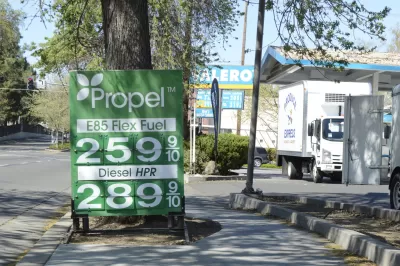
"On Aug. 28, a train between Oakland and Auburn [Placer County, Calif.] began running entirely on the fuel from Golden Gate Petroleum of Martinez — part of a test that, if successful, could herald its use throughout the Capitol Corridor system and in trains statewide," reports Isha Salian for the San Francisco Chronicle.
Planetizen reported on Dec. 14, 2015 that all San Francisco-owned vehicles running on diesel fuel, including its Muni bus fleet, transitioned from a biodiesel blend to 100 percent renewable diesel. Salian adds that Oakland and the San Jose Unified School District have also phased in renewable diesel, "and operators of San Francisco Bay ferries are looking at it too."
The Bay Area is rapidly becoming a center for renewable diesel, which can be made from vegetable oils, restaurants' oil waste or animal fats — material known in the industry as biomass. Unlike biodiesel, which has to be mixed in with petroleum diesel, the new fuel can go into a tank at 100 percent strength.
Demand for the product in California largely stems from the establishment of the Low Carbon Fuels Standards program by the California Air Resources Board, part of the Global Warming Solutions Act of 2006, signed by Gov. Arnold Schwarzenegger. His 2007 executive order (pdf) also established a statewide goal to reduce the carbon intensity of California's transportation fuels by at least 10 percent by 2020.
Gov. Jerry Brown's Executive Order B-30-15 included a goal of reducing (fossil) petroleum consumption 50 percent by 2030, furthering the push toward biofuels.
Demand skyrocketed from 2011 to 2016, from 2 million gallons to 250 million gallons used last year. According to CARB, this is about 7 percent of all diesel used in the state, writes Salian.
'We can sell every drop of renewable diesel we make,' said Eric Bowen, head of corporate business development for the Renewable Energy Group. The company sells the fuel mostly to the California market, he said. Its Louisiana plant can produce 75 million gallons of renewable diesel each year, and it is looking to expand its facilities.
According to an email from Tom Fulks of the Diesel Technology Forum, Gold Gate Petroleum purchases renewable diesel from Iowa-based Renewable Energy Group or Finland-based Neste, the world's largest producer, which they sell under their Neste MY Renewable Diesel brand.
"Simon Mui, senior scientist at the Natural Resources Defense Council (NRDC), said that depending on what the renewable diesel is made from, it can cut lifecycle greenhouse gas emissions by 15 to 80 percent," adds Salian. "Renewable diesel also reduces fine particle pollution and other types of emissions, like nitrogen oxides and carbon monoxide, Mui said."
Challenges
Some experts question how much the renewable diesel market can grow.
'The more we study biofuels, the less clear it is there's very much of a sustainable supply,' said Daniel Kammen, a UC Berkeley professor who helped write California's Low Carbon Fuel Standard. Biofuels are always less efficient than electric vehicles, he said.
While electrifying public transit buses has made enormous progress lately, heavy trucks will still be a challenge.
Sam Wade, chief of the transportation fuels branch at the Air Resources Board, said that while heavy-duty vehicles may eventually switch to electric power, 'there's not that many applications that are fully viable today. We see (renewable diesel) as a nice near-term opportunity.'
'We don't meet our state goals unless we have a full array of those electrified fleets as well as liquid-fuel-based fleets,' adds Mui of NRDC.
Next step for Capitol Corridor
If further tests go well, all Capitol Corridor trains could switch over to renewable diesel by next summer, according to Dean Shepherd, manager of mechanical services.
Jim Allison, manager of planning, Capitol Corridor, estimates that shifting to renewable diesel in all of its locomotives, which each need about 70 gallons of fuel per hour, would reduce the trains' greenhouse gas emissions by two-thirds.
For in-depth information on renewable diesel, see this 2010 evaluation of renewable diesel by UC Berkeley, UC Davis and the California Environmental Protection Agency.
FULL STORY: Renewable diesel use in California moves to fast track


Paying for Climate Change Mitigation at the Pump in California
Two market-based programs add about a quarter to every gallon of fuel purchased in the Golden State, but don't expect to see the prices listed anywhere. Furthermore, costs to comply with the Low Carbon Fuel Standard are expected to increase.
California Reaches Greenhouse Gas Emissions Target Four Years Ahead of Schedule
It is possible to achieve state-mandated global warming reduction goals after all. The nation's first such goal, signed into law by Republican governor Arnold Schwarzenegger in 2006, called for reducing emissions to 1990 levels by 2020.
Can Hydrogen Make a Comeback?
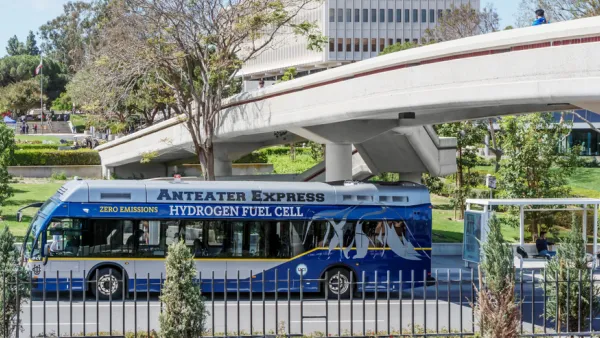
While hydrogen fuel cell electric vehicles are much less popular than their battery-powered siblings, California remains committed to the zero-emission technology, with three state agencies investing in and monitoring its progress.

The state-sanctioned urbicide of Austin
People don’t kill cities. Freeways do.

US to reduce Colorado River water deliveries to Mexico
A new Colorado Treaty amendment reduces Mexico’s Colorado River water allocation by 250,000 acre feet.

New Jersey’s second-largest city bans standalone data centers
Jersey City will continue to allow co-location facilities, such as those meant for research institutions that store their own data.

Amtrak not solely to blame for New Jersey commuter rail's unreliability, report finds
A new study from the Garden State Initiative found that NJ Transit’s budget grew 20% across a 4 year period, but reliability declined significantly over the same period.

EPA erases limits on planet-warming pollution from power plants
Under Monday’s plan, power plants would still have some limits on how much mercury, arsenic and other contaminants they can emit.

Phoenix announces new on-demand transit service, more frequent RAPID buses
Both new services will launch in October, and are part of Phoenix's Project Effective Access Solutions for Easing Congestion.

FREE Course: Walkable City 1: Why Walkability?
After describing his path towards focusing on walkability as the essence of good planning, Jeff Speck marches through his five principal reasons for making more walkable places.
Reinventing Malls: Planning Alchemy—Turning Gray Fields Into Gold
The course focuses on the opportunities and imperatives that shape reinvention of mall sites.

Eagle County Government
Harvard University Graduate School of Design
Nashville Planning Department
The Architects Foundation
University of Cincinnati Online
The Pocatello Development Authority
The Urban Renewal Agency of the City of Pocatello
Journal of the American Planning Association