Thanks to the governor's support, there is reason for optimism that a plan to charge motorists entering Manhattan below 60th St. and toll the East River bridges will have a better outcome than Mayor Michael Bloomberg's plan did in April 2008.


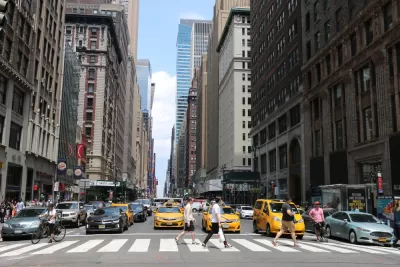
The road ahead for a London-style, cordon pricing plan will not be easy, warns The Times, but the support of Gov. Andrew Cuomo, "one of the few New York politicians with the influence and authority needed to persuade the Legislature to approve it," writes The Times' editorial board, is good news. His critical support may mean the it will not suffer the fate of that of former New York City Mayor Michael Bloomberg's plan, defeated by state lawmakers in Albany in April 2008.
Congestion pricing has many obvious opponents, starting with people who will have to pay new fees to drive into the heart of New York City, as well as their representatives in the Legislature.
The good news is that congestion pricing is finally back on the table. Gov. Andrew Cuomo told The Times that it was an “idea whose time has come,” and that he and his staff were working on a proposal.
But Gov. Cuomo has provided few details on his plan. The Times' editorial board recommends that the governor adopts the Move NY Fair Plan, based on the ideas of Sam Schwartz, a former New York City traffic commissioner
Move NY, which Mr. Cuomo is considering, would impose fees on cars and trucks heading south across 60th Street and vehicles that enter Manhattan from the four East River bridges that are currently free.
- It would lower tolls on outer bridges like the Robert F. Kennedy (still known as the Triborough) and the Verrazano-Narrows that serve areas with few transit options.
- It would increase fees on taxi and ride-share trips in much of Manhattan during the busiest times of day. The fees and tolls would be higher on weekdays and during rush hours, and lower at other times.
- It would raise nearly $1.5 billion a year for improving transit services in the city and the suburbs
Legislation proposed last year by Assemblyman Robert J. Rodriguez (Democrat-East Harlem) and Senator Andrew Lanza (Republican-Staten Island) would implement the Move NY Fair Plan.
However, any plan to impose cordon pricing, a form of congestion pricing applied to a region, such as downtown London or Singapore, as opposed to a toll lane, road or bridge, must first pass the New York City Council, as the Bloomberg plan did on March 31, 2008 and be signed by the mayor.
Unfortunately, New York City's Democratic mayor, Bill de Blasio (Democrat) is opposed to the Move NY Fair Plan and is on record as embracing an income-based as opposed to user fee approach to funding public transit which would do nothing to manage traffic congestion.
FULL STORY: Gov. Cuomo’s Wise Move on Congestion Pricing

Big Push for Congestion Pricing Expected Early Next Year in New York
Ten years after former NYC Mayor Michael Bloomberg's congestion pricing plan died on the state Assembly floor, expect to see a similar plan revived by Gov. Andrew Cuomo (D-N.Y.). New York Times metro reporter, Winnie Hu, explains why it never died.
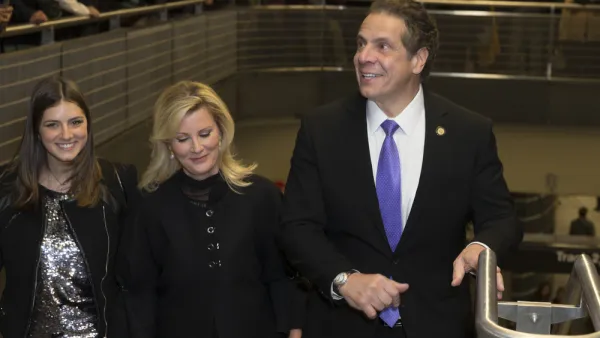
How NY Gov. Andrew Cuomo Came to Support Congestion Pricing
Gov. Andrew Cuomo was not an early endorser of congestion pricing. Why the sudden embrace, particularly when Mayor Bill de Blasio is opposed? Turns out that electronic tolling technology, embraced by the MTA, appears to have moved the governor.
Breaking News: New York State Ready to Embrace Congestion Pricing, Finally
The New York State Legislature is preparing to reverse over a decade of reluctance regarding congestion pricing, according to reports from Albany.

The state-sanctioned urbicide of Austin
People don’t kill cities. Freeways do.

US to reduce Colorado River water deliveries to Mexico
A new Colorado Treaty amendment reduces Mexico’s Colorado River water allocation by 250,000 acre feet.

New Jersey’s second-largest city bans standalone data centers
Jersey City will continue to allow co-location facilities, such as those meant for research institutions that store their own data.

Amtrak not solely to blame for New Jersey commuter rail's unreliability, report finds
A new study from the Garden State Initiative found that NJ Transit’s budget grew 20% across a 4 year period, but reliability declined significantly over the same period.

EPA erases limits on planet-warming pollution from power plants
Under Monday’s plan, power plants would still have some limits on how much mercury, arsenic and other contaminants they can emit.

Phoenix announces new on-demand transit service, more frequent RAPID buses
Both new services will launch in October, and are part of Phoenix's Project Effective Access Solutions for Easing Congestion.

FREE Course: Walkable City 1: Why Walkability?
After describing his path towards focusing on walkability as the essence of good planning, Jeff Speck marches through his five principal reasons for making more walkable places.
Reinventing Malls: Planning Alchemy—Turning Gray Fields Into Gold
The course focuses on the opportunities and imperatives that shape reinvention of mall sites.

Eagle County Government
Harvard University Graduate School of Design
Nashville Planning Department
The Architects Foundation
University of Cincinnati Online
The Pocatello Development Authority
The Urban Renewal Agency of the City of Pocatello
Journal of the American Planning Association