The city of Berkeley has a radical idea for how to build more transitional housing for its sizable homeless population.



Ashley Wong reports: "The city of Berkeley passed an innovative new proposal to build more transitional housing for homeless residents this week — and officials say they plan to put a measure on the 2018 ballot to help pay for it."
The decision culminated a process by which the city considered four options for its "Pathways Project," also detailed in another article by Wong from June 2017. In the end, the council decided on the low cost option: "to fund 100 new beds at city-operated temporary and transitional-housing shelter, to the tune of approximately $2.5 million a year."
In another twist to the plan, the housing "will be constructed in the form of a “tent village,” using bungalow-style tent-cabins, along with port-a-potties, mobile showers, trailers for office and storage space, and security fencing around the perimeter." Mike Zint, a member of the First They Came For The Homeless organization is quoted saying what many are probably thinking in the article, calling the idea "like a concentration camp."
Read the full story: Berkeley Passes Ambitious Plan To Tackle Homelessness, Wants Ballot Measure in 2018 to Help Pay for It

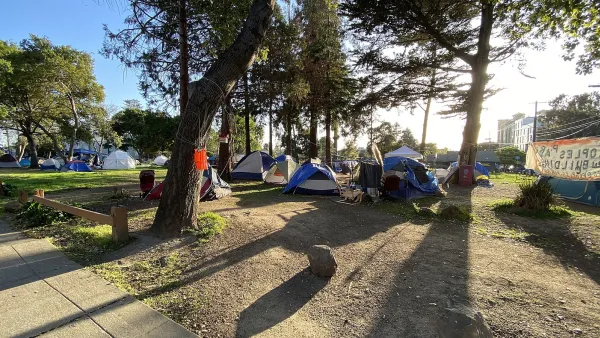
UC Berkeley Commits to Supportive Housing Project in People's Park
The university will work with the city and local nonprofits to provide 42 units of housing and supportive services to unhoused people living in Berkeley's iconic People's Park.
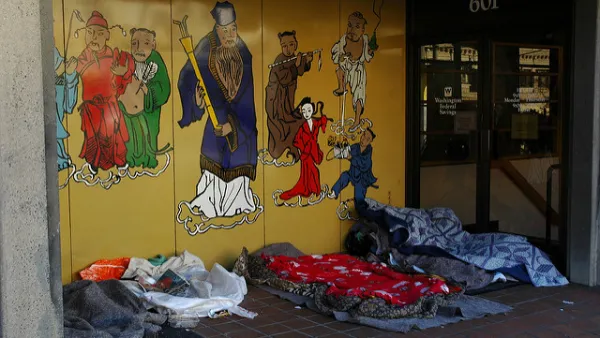
Seattle Tiny-Home Villages Facing Host of Challenges
The villages offer much-needed housing for homeless people, but controversy is brewing over their operations.
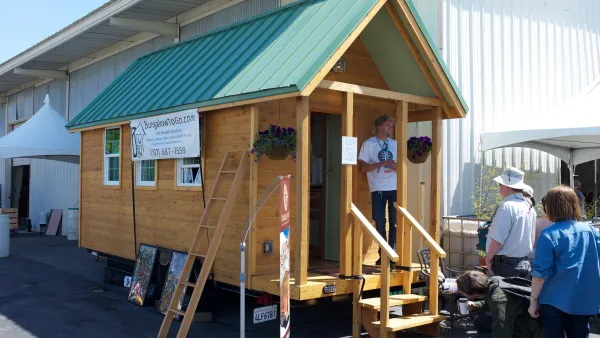
Tiny House Communities Popping Up to Shelter Homeless
Villages of tiny homes are being prepared in Portland and Denver to help individuals transition out of homelessness

Planetizen Federal Action Tracker
A weekly monitor of how Trump’s orders and actions are impacting planners and planning in America.

Amtrak, CN end decades-long dispute with eight-year agreement
The new operating agreement establishes an updated framework for the companies to work together, including processes to resolve disputes.

Judges permit Denver to divert 77,000 acre feet from the Colorado River for reservoir expansion
Overuse and climate change have caused the Colorado River’s water levels to plummet.

NYC DOT wants faster, more permanent street upgrades
The city is examining ways to build more concrete infrastructure without getting entangled in 'decades-long' projects.

'Something we’ve never seen before:' rising utility rates could strain city finances nationwide
Data centers, climate change and other factors have caused utility rates in the United States to increase by 38% since 2020.

Trump to overrule local leaders, lease millions of acres of America’s Pacific Island territories’ seafloors to mining companies
International law says that the Indigenous people of America’s territories have a right to prior and informed consent regarding projects that impact their countries.

FREE Course: Walkable City 1: Why Walkability?
After describing his path towards focusing on walkability as the essence of good planning, Jeff Speck marches through his five principal reasons for making more walkable places.
Reinventing Malls: Planning Alchemy—Turning Gray Fields Into Gold
The course focuses on the opportunities and imperatives that shape reinvention of mall sites.

Harvard University Graduate School of Design
KFH Group Inc.
Greater Baltimore Committee
The Architects Foundation
University of Cincinnati Online
The Pocatello Development Authority
The Urban Renewal Agency of the City of Pocatello