The president spent Infrastructure Week touting a $1 trillion infrastructure investment plan that has yet to materialize, unlike the elimination of an essential grant program in his 2018 budget that will be detrimental to over 50 transit projects.


Infrastructure Week went off largely without a hitch, although the nation was largely captivated with the June 8 congressional hearing of fired FBI director James Comey. At each of the week's four events, Trump emphasized the importance of his $1 trillion infrastructure plan, based on $200 billion of federal investment leveraging $800 billion in private investment over 10 years.
However, like so many of the president's other priorities, the program has been distracted by the Russian cloud over the White House.
"The president...now faces an increasing probability that not only will his proposal fail in Congress but that existing infrastructure efforts will also stumble," report Damian Paletta and Mike DeBonis for The Washington Post. A Pittsburgh bus rapid transit project is cited as an example.
In previously unreported letters, officials at the Department of Transportation [DOT] last week told project managers for a bus corridor in Pittsburgh and rail projects in Phoenix and New York that the administration’s budget plan for next year “proposes no funding for new projects” under an existing federal program known as the Capital Investment Grant."
Robert Rubinstein, who received the letter as executive director of the Urban Redevelopment Authority of Pittsburgh, said the proposed cancellation of funding would effectively kill the project, which has been in the works for 10 years. It would have created an electric-bus corridor between Pittsburgh and nearby Oakland, Pa.
“We don’t have enough resources locally to undertake the larger project,” Rubinstein said. He said officials had sought roughly $80 million in federal money to go toward the $224 million project. He said the several million dollars already spent on studies and engineering reviews could be lost.
Sound familiar? Many in the transit community had seen the warning in February when the DOT deferred to approve a core capacity grant of $647 million for Caltrain electrification in the Bay Area. One reason cited was Republican opposition to the project, but in hindsight, the project might have been deferred regardless for the simple reason that Trump is unwilling to fund projects without a signed Full Funding Grant Agreement.
The phase-out of the Capital Investment Grant Program would eliminate about $2.3 billion of funding for more than 50 public transit projects, according to Andrew Brady, senior director of government affairs at the American Public Transportation Association.
"[Trump] is saying a lot of good things on infrastructure, but what he’s done is implement very real cuts to infrastructure programs,” Brady said.
Capitol Hill aides closely tracking infrastructure funding say that uncertainty over the administration’s infrastructure plans is particularly threatening to programs that are far along and are dependent on federal funding for completion.
Why?
I offer four reasons to explain why Trump wants to decimate public transit spending. It may be more likely a combination of all of them.
- Trump dislikes public transit. However, that would not explain why the Transportation Investment Generating Economic Recovery (TIGER) grant program, "created under the Obama administration in the 2009 stimulus bill and has since funded $5 billion worth of road, rail, port and bicycle projects," is also targeted by Trump for termination.
- Trump wants to have the private sector take up more of the federal government's funding role. After all, look at his infrastructure plan, which relies on 75 percent private funding.
- Similarly, Trump is taking cues from the conservative Heritage Foundation. That was the assertion made in a January post, "Trump Budget Blueprint Would Nix Federal Transit Spending." It also is consistent with their devolution principle: let the states pay for their own projects, and the success of state transportation ballot measures last November would seem to offer proof that they can do so. Furthermore, Transportation Secretary Chao was a distinguished fellow there from 2009 to 2012.
- He is cutting the transportation budget in order to pay for more defense spending as noted in a March post, "President Trump's Other Infrastructure Plan—Defunding Grant Programs."
Hat tip to Michael Keenly.
Read the full story: Multiple transit projects across U.S. at risk as White House infrastructure plan falters

2018 Congressional Transportation Budget Begins to Take Shape
While reduced from current levels, the House Appropriations Committee budgeted far more than what President Trump had proposed, but they agreed with him to eliminate the TIGER grant program and reduce transit investments, though by a lesser amount.
Sacramento Streetcar Faces Uncertain Future Due to Trump Budget
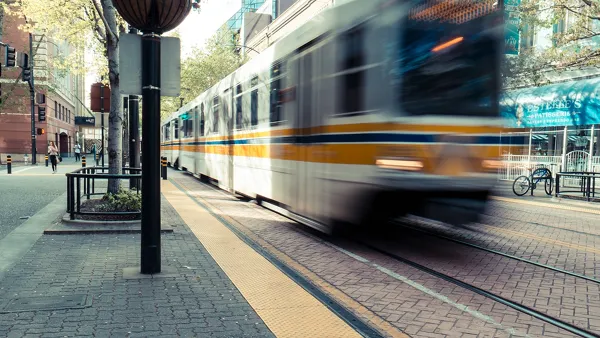
The president's Fiscal Year 2019 Budget cuts the critical Capital investment Grants program run by the Federal Transit Administration. Projects lacking a full-funding grant agreement, like the Sacramento Streetcar, may fall victim.
Senate Appropriations Committee Restores TIGER Grant Program
Unlike the House Appropriations Committee's DOT budget that reduces spending by almost 4 percent from current levels and eliminates the TIGER grant program, its Senate counterpart increased transportation spending, including the TIGER grant budget.

Planetizen Federal Action Tracker
A weekly monitor of how Trump’s orders and actions are impacting planners and planning in America.

Amtrak, CN end decades-long dispute with eight-year agreement
The new operating agreement establishes an updated framework for the companies to work together, including processes to resolve disputes.

Judges permit Denver to divert 77,000 acre feet from the Colorado River for reservoir expansion
Overuse and climate change have caused the Colorado River’s water levels to plummet.

NYC DOT wants faster, more permanent street upgrades
The city is examining ways to build more concrete infrastructure without getting entangled in 'decades-long' projects.

'Something we’ve never seen before:' rising utility rates could strain city finances nationwide
Data centers, climate change and other factors have caused utility rates in the United States to increase by 38% since 2020.

Trump to overrule local leaders, lease millions of acres of America’s Pacific Island territories’ seafloors to mining companies
International law says that the Indigenous people of America’s territories have a right to prior and informed consent regarding projects that impact their countries.

FREE Course: Walkable City 1: Why Walkability?
After describing his path towards focusing on walkability as the essence of good planning, Jeff Speck marches through his five principal reasons for making more walkable places.
Reinventing Malls: Planning Alchemy—Turning Gray Fields Into Gold
The course focuses on the opportunities and imperatives that shape reinvention of mall sites.

Harvard University Graduate School of Design
KFH Group Inc.
Greater Baltimore Committee
The Architects Foundation
University of Cincinnati Online
The Pocatello Development Authority
The Urban Renewal Agency of the City of Pocatello