Improvements in street design and bike infrastructure make life easier on bikers in car-centric Orlando, but employers and politicians could do more in the city to get commuters out of their cars.


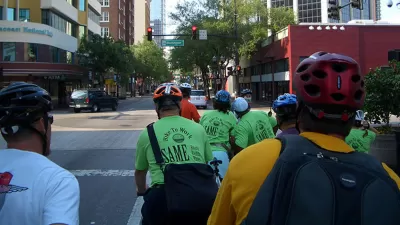
For Kyle Taniguchi everyday is Bike to Work Day. But, as Orlando celebrates bike commuters on May 19th, Taniguchi explores how the city has and hasn't made biking easier. "Orlando has increased the visibility of bike lanes with green paint, supported the creation of a bike-share program, and invested in bicycle repair stations at parks and trails," Taniguchi writes in the Orlando Sentinel. Still, he argues there's more the city could do in building "complete streets" (Orlando was recently ranked the 3rd most dangerous city for pedestrians by Smart Growth), and the city's employers could do more as well.
"A lot of employers aren’t aware that they could help support bike commuting and other methods of sustainable mobility by offering commuter benefits meant to reduce employees’ reliance on individual cars," Taniguchi writes.
Read the full story: Bike to Work Day challenges Orlando car culture
The Rippling Effects of Bike-to-Work Subsidies
A European movement to incentivize people to commute by bicycle is changing travel patterns and making mobility more sustainable.
Cycling Rates Remain High Across the Country
The bike boom that began during the pandemic shows no signs of abating, according to a new report.

Providence the Latest City to Get Toilet-Plunger Bike Lane
Bike advocates are plumbing new depths, with a growing trend toward placing plungers to act as separators for bike lanes.

Planetizen Federal Action Tracker
A weekly monitor of how Trump’s orders and actions are impacting planners and planning in America.

California plans to bury El Niño’s downpour
If the state plays its cards right, it may be able to store a billion acre-feet of El Niño’s water in aquifers.

Desperate measures: Advocates weigh draining Lake Powell to fill Colorado River
Draining the reservoir could reduce evaporation losses by a couple hundred thousand acre-feet.

US buildings threatened, destroyed by fires set to triple by 2060
Researchers found a high fire risk for socioeconomically vulnerable neighborhoods in the American West.

LA residents may be allowed to paint their own crosswalks
Councilwoman Katy Yaroslavsky put out a motion instructing the Los Angeles Department of Public Transportation to study the feasibility of allowing volunteers to paint crosswalks.

Dallas moves to overhaul its zoning code
The city's zoning reform will allow more multi-family and mixed-use developments.

FREE Course: Walkable City 1: Why Walkability?
After describing his path towards focusing on walkability as the essence of good planning, Jeff Speck marches through his five principal reasons for making more walkable places.
Reinventing Malls: Planning Alchemy—Turning Gray Fields Into Gold
The course focuses on the opportunities and imperatives that shape reinvention of mall sites.

City of Rosemead
Rutgers University, Edward J. Bloustein School of Planning and Public Policy
One Hundred Miles
Hunter College, City University of New York (CUNY)
The Architects Foundation
University of Cincinnati Online
City of Cambridge
Montrose County
The Pocatello Development Authority