Dehli announced a major new Complete Streets program that will redesign urban roads to favor walking, cycling and public transport over car traffic. This is very good news. It shows that the Complete Streets concept is now being applied worldwide.,



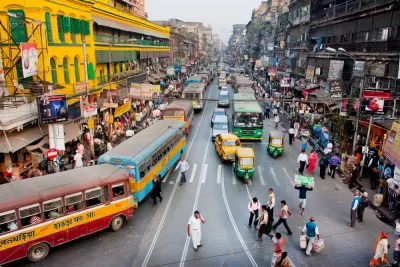
I am a great advocate of Complete Streets, which means that urban roadways are designed to accommodate diverse users and uses, including walking, cycling, public transit, plus nearby residents and businesses, in addition to automobile traffic. This increases urban transportation efficiency and equity by ensuring that all travel modes are safe and convenient.
This is a major paradigm shift, a fundamental change in the way problems are defined and potential solutions evaluated, from automobile-oriented to multimodal. Complete Streets planning has been widely embraced by North American professional organizations such as the Institute of Transportation Engineers, but is not as well established in developing countries, at least, not yet. Delhi, India's new plan to redesign ten major city roads to favor walking, cycling and public transit over automobile travel is very good news. It shows that the Complete Streets concept is making inroads in India and other Asian countries. This is a huge change and an important opportunity for improving the safety and livabilty of all residents, particularly lower-income people who walk and bike. I hope this project is successful and becomes an example for other cities in India and around the world.
Asian planners have developed some terrific multi-modal roadway design resources:
Moving Dangerously, Moving Pleasurably: Improving Walkability in Dhaka; Using a BRT Walkability Strategy to Make Dhaka’s Transportation Infrastructure Pedestrian-Friendly by the Asian Development Bank.

Changing Course in Urban Transport- An Illustrated Guide by the Sustainable Urban Transport Project and GIZ.

Better Street, Better Cities: A Guide To Street Design In Urban India by the Institute for Transportation and Development Policy.

Mobility For All A Strategic Transportation Plan For Ranchi by the Institute for Transportation and Development Policy for the Ranchi Mobility Partnership.

Walkability and Pedestrian Facilities in Asian Cities: State and Issues, Sustainable Development Working Paper, Asian Development Bank.

Safety, Sustainability and Future Urban Transport by the Eicher Group.

Working Group on Urban Transport Final Report by the National Transport Policy Development Committee, Ministry of Urban Development (MoUD), Government of India.

Pedestrian Design Guidelines: Don’t Drive…Walk by the Delhi Development Authority, New Delhi.

Walkability Asia supports walkability improvements in Asian countries.
Traffic & Transportation Policies and Strategies in Urban Areas in India by the India Ministry of Urban Development.

Environmentally Sustainable Transport For Asian Cities: A Sourcebook by the United Nations Centre for Regional Development.

Istanbul: An Accessable City – A City For People by EMBARQ Turkey .

These are world-class resources that should be useful to Complete Streets advocates everywhere. Congratulations to my colleagues in India. Well done and good luck!
California Updates Main Street Planning Guide
A newly revised guidebook by the California Department of Transportation describes how to plan and design highways and arterials that also serve as community commercial centers.
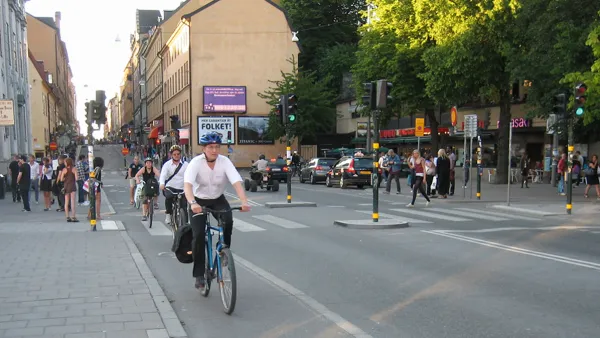
Rethinking Streets: New Report Illustrates Complete Streets Projects
"Rethinking Streets," a new report by the University of Oregon's Sustainable Cities Initiative, provides detailed information on 25 complete streets and streetscaping projects. It is available free in PDF and hard copy format.
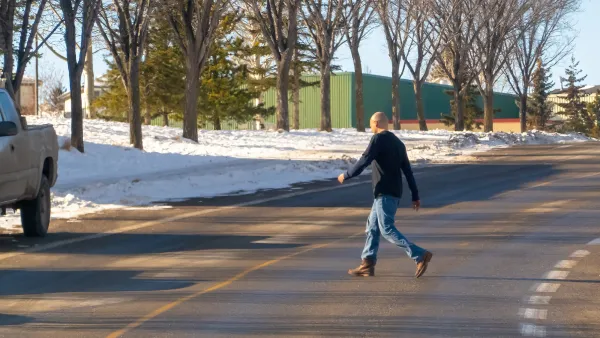
Study: Midblock pedestrian crossings are more common than we think
One in six crossings in the study took place outside of a marked crosswalk.

Planetizen Federal Action Tracker
A weekly monitor of how Trump’s orders and actions are impacting planners and planning in America.

California plans to bury El Niño’s downpour
If the state plays its cards right, it may be able to store a billion acre-feet of El Niño’s water in aquifers.

Desperate measures: Advocates weigh draining Lake Powell to fill Colorado River
Draining the reservoir could reduce evaporation losses by a couple hundred thousand acre-feet.

US buildings threatened, destroyed by fires set to triple by 2060
Researchers found a high fire risk for socioeconomically vulnerable neighborhoods in the American West.

LA residents may be allowed to paint their own crosswalks
Councilwoman Katy Yaroslavsky put out a motion instructing the Los Angeles Department of Public Transportation to study the feasibility of allowing volunteers to paint crosswalks.

Dallas moves to overhaul its zoning code
The city's zoning reform will allow more multi-family and mixed-use developments.

FREE Course: Walkable City 1: Why Walkability?
After describing his path towards focusing on walkability as the essence of good planning, Jeff Speck marches through his five principal reasons for making more walkable places.
Reinventing Malls: Planning Alchemy—Turning Gray Fields Into Gold
The course focuses on the opportunities and imperatives that shape reinvention of mall sites.

City of Rosemead
Rutgers University, Edward J. Bloustein School of Planning and Public Policy
One Hundred Miles
Hunter College, City University of New York (CUNY)
The Architects Foundation
University of Cincinnati Online
City of Cambridge
Montrose County
The Pocatello Development Authority

