A newly revised guidebook by the California Department of Transportation describes how to plan and design highways and arterials that also serve as community commercial centers.


Main Street, California: A Guide for Improving Community and Transportation Vitality is a newly revised guidebook produced by the by California Department of Transportation which describes how to plan and design highways and arterials that also serve as community commercial centers.
Just as mobility is essential to California’s economic and civic vitality, the planning, design and operation of main streets is tied to the prosperity of local communities. Well conceived main streets function efficiently as multimodal transportation facilities, and are important civic spaces that support vibrant community life and ecological health. Prudent investments to provide multimodal travel options are a crucial strategy for reducing greenhouse gas emissions and other environmental impacts associated with single occupancy driving habits.
Incorporating principles of livability and sustainability into main street projects can help balance the need for an efficient multimodal transportation facility with local needs for a main street that functions as the heart of the community. Some design solutions highlighted in Main Street will be familiar or slight variations of traditional strategies, while others will entail a new and broader vision of how main streets can benefit travelers and the local community.
Arriving at a shared vision for main streets requires a commitment to collaborative negotiation and shared responsibility. This document will assist transportation officials, designers, planners and stakeholders in making transportation decisions that are appropriate for the local context and that serve the greater traveling public.
Read the full story: Main Street, California: A Guide for Improving Community and Transportation Vitality

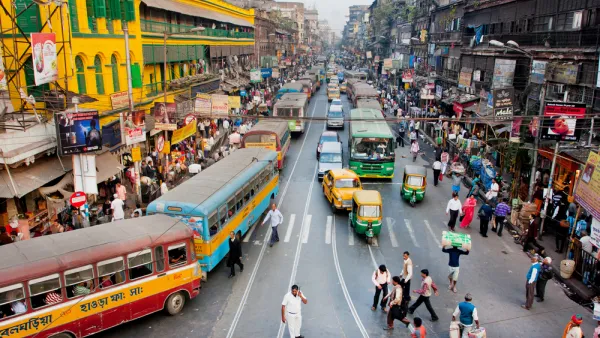
Complete Streets Concepts Are Now Being Applied Worldwide
Dehli announced a major new Complete Streets program that will redesign urban roads to favor walking, cycling and public transport over car traffic. This is very good news. It shows that the Complete Streets concept is now being applied worldwide.,
Transportation Professionals: How Should Your 'Professional Obituary' Read?
As the debate between ‘traditional’ transportation engineering and smarter cities continues, professionals should consider by what measure of success they want to be remembered.

Anatomy of a NIMBYcide in Santa Monica
A look at how the previous approval of the Hines Bergamont Transit Village project was rescinded after pressure from community activists, by real estate developer and consultant Michael Russell.

Planetizen Federal Action Tracker
A weekly monitor of how Trump’s orders and actions are impacting planners and planning in America.

Amtrak, CN end decades-long dispute with eight-year agreement
The new operating agreement establishes an updated framework for the companies to work together, including processes to resolve disputes.

Nation's most wind-powered state turns to coal as data centers increase energy demand
For the first time in decades, Iowa has increased its generation of coal power.

Alabama scores up to $2.5 billion federal loan for largest infrastructure project in state’s history
The Mobile River Bridge and Bayway Project aims to ease congestion at Alabama’s worst bottleneck.

Trump is considering data centers on 6 states' public land — some state officials say they had no idea
If the administration approves the proposed projects, data center and data center-related developments will cover 17,600 acres of public land.

Despite court ruling, Trump is keeping nearly all wind projects in the US on hold
At least 110 wind energy projects have not heard from the government since a federal judge ruled that the Trump administration's freeze on wind turbine clearances was likely illegal.

FREE Course: Walkable City 1: Why Walkability?
After describing his path towards focusing on walkability as the essence of good planning, Jeff Speck marches through his five principal reasons for making more walkable places.
Reinventing Malls: Planning Alchemy—Turning Gray Fields Into Gold
The course focuses on the opportunities and imperatives that shape reinvention of mall sites.

KFH Group Inc.
Greater Baltimore Committee
Eagle County Government
The Architects Foundation
University of Cincinnati Online
The Pocatello Development Authority
The Urban Renewal Agency of the City of Pocatello