Controversy erupted last week in Washington, D.C., after D.C. Metro decided to paint Union Station's vaulted ceilings—a famous icon of the District, it's regional transit system, and the architectural style of Brutalism.


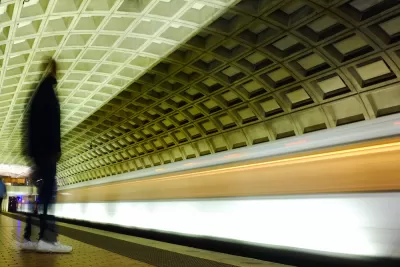
Martin Austermuhle and Amanda Kolson Hurley both took to the pages of their respective media outlets to document the outcry against a controversial decision by the Washington Metropolitan Area Transit Authority (WMATA) to paint a coat of white paint over the station's famous grey vault.
Austermuhle reports that the WMATA's Back2Good campaign is responsible for the paint job—one project among plans to power-wash, scrub, and polish all of the system's 91 stations on an annual basis.
The decision to paint Union Station, however, prompted strong responses from writers like Kriston Capps and Kolson Hurley.
After initially voicing concern on Twitter, Kolson Hurley eventually wrote an article for Washington City Paper, describing the decision to pain Union Station as troubling for "multiple reasons":
"First…dirt will show up prominently on a background of white paint," writes Kolson Hurley. "Second, exposed concrete is integral to the Brutalist style in which the Metro system was designed."
An update to the latter article notes that the Washington chapter of the American Institute of Architects had since expressed "deep concern" over the painting of the Union Station vault.
Read the full story: Metro’s Effort To Create A Brighter Station Is Met With ‘Brutal’ Opposition
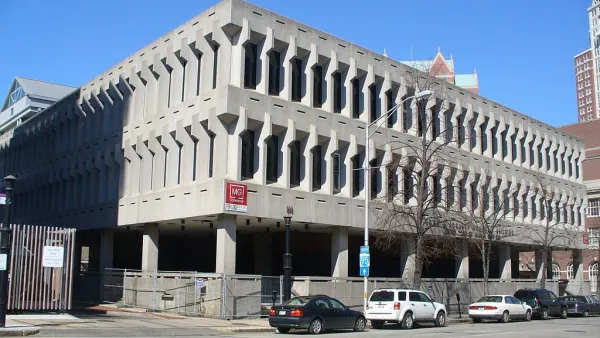
Brutalism Becoming a Source of Preservation Controversy
Brutalism might not be anybody's idea of beautiful, but that doesn't mean examples of the architectural style aren't beloved by many. As Brutalism comes of age as historic, preservation battles are heating up—especially in Washington, D.C.
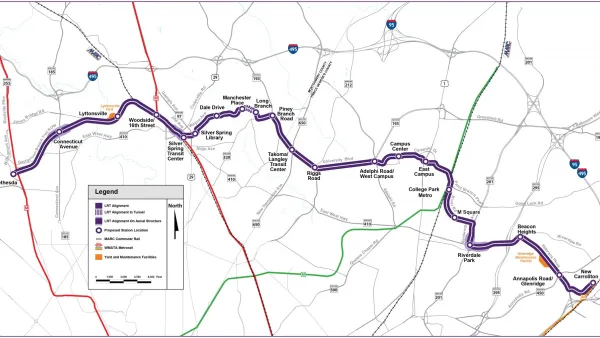
Court Ruling Could Be a Final Setback for Maryland Purple Line Extension
A recent ruling by a U.S. district court could be a deathblow for the 16-mile Purple Line extension into Maryland, as well as for transit planning in general.
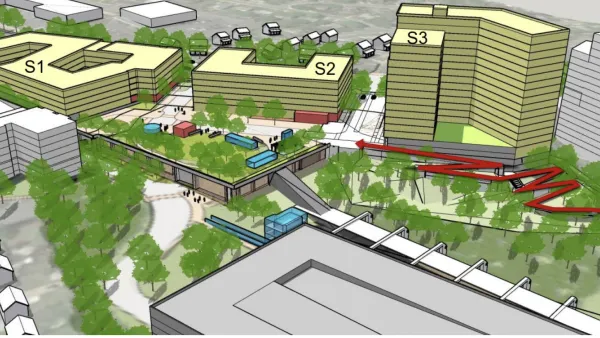
A New Transit Oriented Vision for Fairfax County, Virginia
A new transit station area plan is reaching the finishing line for the Huntington Metro station, serving the WMATA’s Yellow Line in Northern Virginia.

Planetizen Federal Action Tracker
A weekly monitor of how Trump’s orders and actions are impacting planners and planning in America.

California plans to bury El Niño’s downpour
If the state plays its cards right, it may be able to store a billion acre-feet of El Niño’s water in aquifers.

Desperate measures: Advocates weigh draining Lake Powell to fill Colorado River
Draining the reservoir could reduce evaporation losses by a couple hundred thousand acre-feet.

Mamdani’s pied-à-terre tax survives legal challenge
A panel of judges found that the plaintiffs failed to demonstrate injury as a result of New York City's implementation of the tax.

Eastern Nebraska is running out of electricity
Data centers and electrification are straining eastern Nebraska’s grid, throttling economic development.

Seattle passes record-breaking transit services expansion
Proposition 1 will double the city’s transit tax to add 95,000 more bus trips and preserve 180,000 bus trips annually.

FREE Course: Walkable City 1: Why Walkability?
After describing his path towards focusing on walkability as the essence of good planning, Jeff Speck marches through his five principal reasons for making more walkable places.
Reinventing Malls: Planning Alchemy—Turning Gray Fields Into Gold
The course focuses on the opportunities and imperatives that shape reinvention of mall sites.

City of Rosemead
Rutgers University, Edward J. Bloustein School of Planning and Public Policy
One Hundred Miles
University of Michigan School for Environment and Sustainability (SEAS)
Hunter College, City University of New York (CUNY)
The Architects Foundation
City of Cambridge
Montrose County
The Pocatello Development Authority