Unlike the nation's more well-known high-speed rail project in California, the 205 miles-per-hour, Dallas-to-Houston bullet train will be almost entirely privately financed. How is that possible?


To hear the executives at Texas Central Partners, LLC (Texas Central) speak, their "bullet train [is] not only possible, but inevitable....," writes Jill Cowan, economy reporter for The Dallas Morning News. The train will travel the 240 miles from Dallas to Houston in 90 minutes.
"Entrepreneurial risk will be borne by investors who understand that,” Texas Central president Tim Keith said. “The appetite for infrastructure assets by global investors is huge.”
Investors
Investors will provide "roughly a third of the project," Keith said. "The other two-thirds will be debt."
"So far, Texas Central has raised about $115 million from investors," notes Cowan. See July 2015 post on the first $75 million raised. Still, that leaves $3.885 billion to go. Look for "money managers of huge pots of money, like private equity funds or pension funds," Keith said, to step up to the plate.
The McKinsey Global Institute recently noted that institutional investors — like the pension and private equity funds Keith mentioned — “seem like an obvious source of capital” in a world where increasingly urgent infrastructure projects are seriously underfunded.
Another possible, if not likely investor is Japan Bank for International Cooperation whose "main purpose is to promote economic cooperation between Japan and overseas countries by providing resources to foreign investments and by fostering international commerce," according to Wikipedia. As posted in August 2014, Texas Central will be using Central Japan Railway's "N700-I Bullet based on the Tokaido Shinkansen that is currently operating in Japan with a nearly 50-year perfect safety record and an average annual delay of less than one minute."
Cowan updates us on the financing relationship between Texas Central and JBIC:
Tetsuro Amano, the Houston-based general consul of Japan for Texas and Oklahoma, said the technology partnership with Japan Central Railway is definitely “good business,” but it’s too soon to speculate on the Japanese bank’s level of involvement.
Cowan adds that private investors will look for governments to help foster their investment by loosening regulatory barriers, which is music to the ears of the Trump Administration. The project has already caught their attention as it ranked #13 on a preliminary priority infrastructure list of 50 projects. Absent from the list is Texas Central's California counterpart.
Revenues
Unlike the California project, backed with over $3 billion in matching federal grants from former President Obama, almost $10 billion from the 2008 ballot measure that authorized the project, and guaranteed to receive one-quarter of the sale of carbon allowances from the state's embattled cap-and-trade fund, the main revenue source for Texas Central will be ticket sales.
“This project is fully financeable based on ticket sales,” Keith said.
Cowan goes on to write about those who question Keith's assertion. A more optimistic, but still cautious prognosis is offered by Michael Bennon, managing director of Stanford University’s Global Projects Center.
“This project is in a whole new league,” he said. “There’s no real precedent for high-speed rail financed completely by the private market in the U.S.”
Ethan Elkind, who writes about transportation and infrastructure, wrote last year that success for Texas Central would benefit the beleaguered California project.
Correspondent's note: Cowan's piece is also available via The Texas Tribune.
Read the full story: How to pay for Texas' $12 billion bullet train without asking the state for money

High-Speed Rail: What's Good for Texas Is Good for California
It's becoming clear that Texas will beat California to having the first all high-speed train on the continent. Ethan Elkind suggests three ways that success for Texas Central's Dallas-to-Houston line will benefit the struggling California project.
Reclaiming Malls: How About a High-Speed Rail Station?
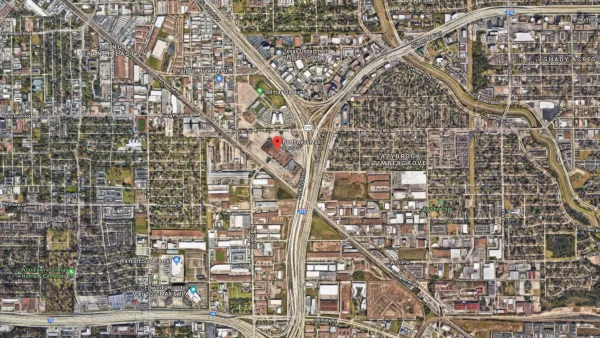
A Texas mall that opened in 1968 and largely closed ten months ago has been picked by Texas Central Partners as the Houston terminal of the Dallas-to-Houston high-speed rail. The site is far from downtown and distant from public transit.
More than Twenty Bills Introduced in Texas Legislature to Stop High-Speed Rail
The California high-speed rail project is not alone in confronting legal and political obstacles. The main issue in Texas that has aroused opposition to the privately financed, 240-mile Dallas to Houston bullet train is the use of eminent domain.

Planetizen Federal Action Tracker
A weekly monitor of how Trump’s orders and actions are impacting planners and planning in America.

California plans to bury El Niño’s downpour
If the state plays its cards right, it may be able to store a billion acre-feet of El Niño’s water in aquifers.

Desperate measures: Advocates weigh draining Lake Powell to fill Colorado River
Draining the reservoir could reduce evaporation losses by a couple hundred thousand acre-feet.

Chicago voters approve permanent festival grounds, penalty for vacant property owners
Currently, major summer and fall festivals take over public parks for weeks at a time, drawing criticism from nearby residents

NYC votes to cut outdoor dining red tape, speed up permitting
New York City also voted to allow the Department of Transportation to begin work on urgent projects before notifying elected officials.

California appears to reject Prop. 45
The proposition would have expanded the projects that qualify for a streamlined environmental review, effectively paring down the California Environmental Quality Act.

FREE Course: Walkable City 1: Why Walkability?
After describing his path towards focusing on walkability as the essence of good planning, Jeff Speck marches through his five principal reasons for making more walkable places.
Reinventing Malls: Planning Alchemy—Turning Gray Fields Into Gold
The course focuses on the opportunities and imperatives that shape reinvention of mall sites.

City of Rosemead
Rutgers University, Edward J. Bloustein School of Planning and Public Policy
One Hundred Miles
Hunter College, City University of New York (CUNY)
The Architects Foundation
University of Cincinnati Online
City of Cambridge
Montrose County
The Pocatello Development Authority