Pedestrians of color are more likely to be killed in traffic crashes.


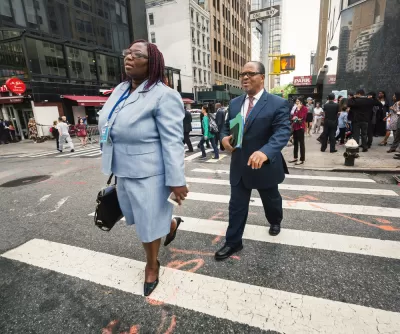
Traffic fatalities have been rising overall across the United States, and the percentage of pedestrians killed is growing. But the impact of these trends is not evenly felt across demographics: Pedestrians of color are more likely to be killed in traffic.
NPR's Morning Edition explores a study in Las Vegas that found that cars were less likely to stop for a black pedestrian than a white one crossing the street—suggesting that driver bias is a real factor in the racial distribution of traffic fatalities.
Correspondent Shankar Vedantam says researchers have been aware of this issue for "quite some time," and there's more research to be done. A larger study could yield additional reasons for the disparity—for instance, "that people of color are just more likely to be pedestrians." When that factor is controlled for, another could be that "minority neighborhoods have less safe traffic intersections"—making a case for focusing on racial equity in transportation planning.
Read the full story: Researchers Examine Race Factor In Car Crashes Involving Pedestrians

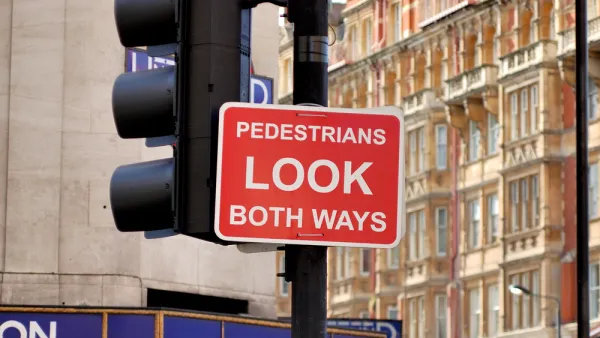
Jaywalking Legalized in Virginia
Beginning in March, police will no longer be able to stop people for crossing the street outside of a crosswalk, a small component of reform intended to protect BIPOC from the historically discriminatory application of traffic laws.
The Dilemma of Autonomous Vehicle Testing
Autonomous vehicles hold the potential to greatly reduce auto crashes. Advocates want them on the road as early as possible to reduce fatalities. Skeptics worry that the public will be guinea pigs during the testing—case in point: Elaine Herzberg.
Tempe Police Chief: Uber AV vs. Pedestrian Crash May Have Been Unavoidable
After viewing the videos taken by two cameras equipped in the Uber autonomous vehicle that fatally struck 49-year-old Elaine Herzberg on Sunday, the chief concluded the crash was difficult to avoid. Also, lessons on the crash from David Leonhardt.

Planetizen Federal Action Tracker
A weekly monitor of how Trump’s orders and actions are impacting planners and planning in America.

Amtrak, CN end decades-long dispute with eight-year agreement
The new operating agreement establishes an updated framework for the companies to work together, including processes to resolve disputes.

Northwest rail fans eager for Sept. 30 debut of Amtrak’s Airo fleet
Get ready for that new train smell and more seats. But they won’t go faster or run more frequently on the Cascades route in Washington and Oregon.

Trump administration unlawfully slashed $7 billion in clean energy grants, judge rules
The Environmental Protection Agency ended the Solar For All program, which provided the grants, after President Donald Trump’s inauguration.

Record-breaking wildlife overpass in Colorado brings 91% reduction in animal collisions
Prior to the overpass, vehicles were hitting one deer per day on Colorado’s Interstate 25.

California lawmakers approve just 5% of much-needed LA28 transportation funding
State legislators appear just as unwilling as Trump to pay for Olympics-related transportation projects.

FREE Course: Walkable City 1: Why Walkability?
After describing his path towards focusing on walkability as the essence of good planning, Jeff Speck marches through his five principal reasons for making more walkable places.
Reinventing Malls: Planning Alchemy—Turning Gray Fields Into Gold
The course focuses on the opportunities and imperatives that shape reinvention of mall sites.

City of Thousand Oaks
City of Wisconsin Rapids
Harvard University Graduate School of Design
The Architects Foundation
University of Cincinnati Online
The Pocatello Development Authority
The Urban Renewal Agency of the City of Pocatello