Tolls on interstate highways are being pushed in Indiana as a means to increase road funding, no easy task even if a waiver is given. The bill would also increase the gas tax and charge electric vehicle owners a fee for road maintenance.


While House Bill 1002 would tackle many parts of the transportation funding equation, the thrust of the article by Daniel C. Vock, Governing’s transportation and infrastructure reporter, lays with tolling.
Tolls have been a fact of life in Indiana for at least 60 years, but state Rep. Edmond Soliday thinks there will have to be more of them if the state wants to keep its roads in good shape.
Soliday, a Republican who chairs his chamber’s transportation committee, said the most expensive part of the state’s transportation network are the heavily trafficked interstates that are filled with out-of-state trucks. Federal law, however, prevents states from tolling existing interstates without a waiver. [Italics added].
[HB 1002] would instruct the Indiana Department of Transportation to apply for a federal waiver and to study how tolls could be added.
A February 2016 Congressional Budget Office (CBO) report [PDF] recommended interstate tolls, along with vehicle-miles-travelled fees as funding options. And the federal transportation reauthorization bill, the FAST Act, signed by former President Obama on December 4, 2015, made changes to that effect, as posted here last February:
[Those changes were] good for states willing and ready to add tolls to interstates, not good for Missouri, North Carolina and Virginia—the three states that had prior authorization to add tolls. They now "will have one year to move ahead with plans to add tolls or lose their slots to other states ready to add tolls to their highways," wrote Ron Nixon And Danielle Ivory for The New York Times. "The new states then would have three years to complete projects or be removed from the pilot."
Missouri was considering a proposal to toll I-70 which stalled in 2012; North Carolina had a proposal to toll I-95, and Virginia ran into stiff opposition to toll a 179-mile stretch of Interstate 95. Even the Southern Environmental Law Center joined in opposition to the toll proposal.
The latest news report this correspondent found was that the I-95 proposals by North Carolina and Virginia were unsuccessful. See related post, also based on a Governing article.
Without the support of "GOP Gov. Eric Holcomb, [who] is reportedly against the idea," notes Vock, it's unlikely Indiana would be on the new list.
Gas Tax, Tolls, Electric Vehicle (EV) Fees, Registration Fees
Total state gas taxes and fees in Hoosier State as of New Year's was 33.59 cents per gallon [PDF]. As noted in "New Years Day State Gas Tax Increases...," the gas tax varies each month with the price of gas. It has increased 2.39 cents since Nov. 1.
HB 1002 also allows for a one-time gas tax increase of up to 10-cents per gallon. In addition, it:
- Requires a person who registers an electric vehicle to pay a supplemental registration fee of $150 with an increase every five years based on an index factor.
- Increases annual registration fees for certain motor vehicles with a declared gross weight that equals or exceeds 26,000 pounds.
- Repeals restrictions on when a tolling project can be undertaken.
Last February, the Indiana House passed a 4-cents gas tax increase bill written by Soliday only to see the tax increases stripped from the bill by the Senate in March. [See related post.]
FULL STORY: As Gas-Tax Profits Decline, More States May Turn to Tolls

Tolling the Interstates: Will Indiana be the First?
Indiana is on track to be the first state to apply new tolls on all lanes of selected interstate highways if they are successful in their application for a waiver from the Federal Highway Administration.
Tennessee Governor Poised to Raise Gas Tax by Six Cents per Gallon
Both chambers of Tennessee's General Assembly approved Gov. Bill Haslam's transportation plan on April 19, which hikes diesel taxes by 10 cents per gallon but lowers other taxes. Indiana appears poised to follow with a 10-cent gas tax increase.
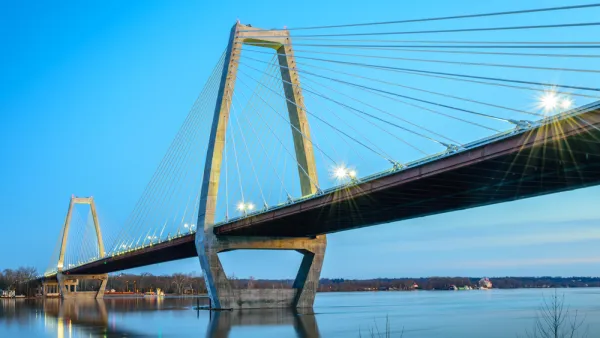
Indiana Advances Interstate Tolling Plans
The Hoosier State is on a roll, infrastructure speaking. Having passed its largest highway investment package last year based on a 10-cents per gallon gas tax hike, it initiated a study to determine the revenue potential for tolling interstates.

The state-sanctioned urbicide of Austin
People don’t kill cities. Freeways do.

US to reduce Colorado River water deliveries to Mexico
A new Colorado Treaty amendment reduces Mexico’s Colorado River water allocation by 250,000 acre feet.

New Jersey’s second-largest city bans standalone data centers
Jersey City will continue to allow co-location facilities, such as those meant for research institutions that store their own data.

Amtrak not solely to blame for New Jersey commuter rail's unreliability, report finds
A new study from the Garden State Initiative found that NJ Transit’s budget grew 20% across a 4 year period, but reliability declined significantly over the same period.

EPA erases limits on planet-warming pollution from power plants
Under Monday’s plan, power plants would still have some limits on how much mercury, arsenic and other contaminants they can emit.

Phoenix announces new on-demand transit service, more frequent RAPID buses
Both new services will launch in October, and are part of Phoenix's Project Effective Access Solutions for Easing Congestion.

FREE Course: Walkable City 1: Why Walkability?
After describing his path towards focusing on walkability as the essence of good planning, Jeff Speck marches through his five principal reasons for making more walkable places.
Reinventing Malls: Planning Alchemy—Turning Gray Fields Into Gold
The course focuses on the opportunities and imperatives that shape reinvention of mall sites.

Eagle County Government
Harvard University Graduate School of Design
Nashville Planning Department
The Architects Foundation
University of Cincinnati Online
The Pocatello Development Authority
The Urban Renewal Agency of the City of Pocatello
Journal of the American Planning Association