The Sun Belt continues to grow while the rest of the country's population growth continues to slow.



Census data released December 20 show big changes in the U.S. population, including slowing growth. "Overall, the United States seems to be in the midst of a population growth paradox: As the nation’s population growth continues to stagnate due to fertility declines in the context of an aging population, internal population shifts help places like the Sun Belt continue to grow," William H. Frey writes for the Brookings Institution.
Early indications from employment information led many to suspect that there would be large intra-state migration. That prediction seems to have been born out. Southwestern states in the Sun Belt are among the country's fastest growing, "Seven of the eight fastest growing states are located in the West: Utah, Nevada, Idaho, Washington, Oregon, Colorado, and Arizona," Frey reports.
Of particular interest is the slow rate of growth for the nation overall. This is partly due to slowing birth trend and a rising death rate (expected to continue as the population continues to age), and partly due to immigration decline. Population growth for the country is currently at a pace not seen since 1936-37.
Read the full story: U.S. growth rate hits new low as migration to the Sun Belt continues

Nevada sues feds to block Colorado River cuts
The federal government’s newly released plan for managing the Colorado River’s dwindling water supply could cause Nevada to lose over 70% of its allocated water.
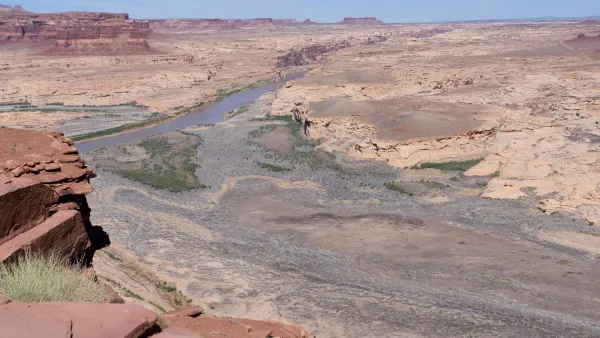
Feds say Arizona, California and Nevada must cut Colorado River water use by 1.25 million acre-feet
The new plan does not apply mandatory cuts to any of the river’s upper basin states.

Popular transit payment system linked to Palantir could give ICE access to rider data
The tap-to-pay system is being used widely in transit systems including New York City, Boston and Chicago.

Planetizen Federal Action Tracker
A weekly monitor of how Trump’s orders and actions are impacting planners and planning in America.

California plans to bury El Niño’s downpour
If the state plays its cards right, it may be able to store a billion acre-feet of El Niño’s water in aquifers.

Desperate measures: Advocates weigh draining Lake Powell to fill Colorado River
Draining the reservoir could reduce evaporation losses by a couple hundred thousand acre-feet.

Mamdani’s pied-à-terre tax survives legal challenge
A panel of judges found that the plaintiffs failed to demonstrate injury as a result of New York City's implementation of the tax.

Eastern Nebraska is running out of electricity
Data centers and electrification are straining eastern Nebraska’s grid, throttling economic development.

Seattle passes record-breaking transit services expansion
Proposition 1 will double the city’s transit tax to add 95,000 more bus trips and preserve 180,000 bus trips annually.

FREE Course: Walkable City 1: Why Walkability?
After describing his path towards focusing on walkability as the essence of good planning, Jeff Speck marches through his five principal reasons for making more walkable places.
Reinventing Malls: Planning Alchemy—Turning Gray Fields Into Gold
The course focuses on the opportunities and imperatives that shape reinvention of mall sites.

City of Rosemead
Rutgers University, Edward J. Bloustein School of Planning and Public Policy
One Hundred Miles
University of Michigan School for Environment and Sustainability (SEAS)
Hunter College, City University of New York (CUNY)
The Architects Foundation
City of Cambridge
Montrose County
The Pocatello Development Authority