Income inequality, housing affordability, and systemic racism join sea-level rise as key issues in Oakland's vision for urban resilience.


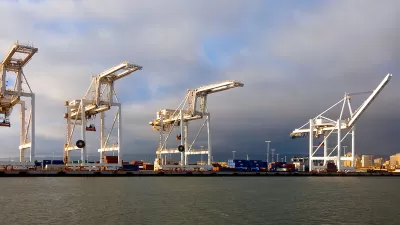
Like many resilience strategies, the Resilient Oakland Playbook outlines plans to prepare aging infrastructure for the drought conditions, increased wildfires, and sea-level rise that will likely impact the California city in the coming years.
But while climate impacts might be where some plans stop, Oakland has taken the approach that social and racial equity, an inclusive economy, and citizen empowerment are also crucial to the city’s overall sustainability.
"Our greatest barriers to resiliency are addressing our day-to-day social stresses, including equitable access to quality jobs, education, affordable housing, community safety and better infrastructure," Chief Resiliency Officer Kiran Jain told Next City.
Oakland does address these problems individually: The city has a goal of producing zero waste by 2020. It has taken steps to tackle its housing crisis, and recently launched its first Department of Transportation, which will take a complete streets approach to transportation planning. The state is also developing a regional plan to address sea-level rise in the Bay Area. The new "playbook" serves to connect separate departments under a common framework.
It is an element of the city’s participation in the Rockefeller Foundation’s 100 Resilient Cities (100RC) program, which provides cities worldwide technical support and funding for resiliency programs. Oakland hired its first chief resiliency officer through 100RC in 2014.
Read the full story: Oakland Publishes Playbook for a Resilient Future

San Francisco's Vision for Seismic and Social Resilience
The progressive city hopes to integrate economic, community, and climate resiliency measures in future projects.
Op-Ed: Talking Resilience Isn't the Same as Being Resilient
Resilience, as such, isn't a problem. But Alex Beam takes issue with the current flood of resilience-related jargon. Can you blame him?
First 'Chief Resilience Officer' Begins Term in Oakland
Victoria Salinas was recently named Oakland, California's first Chief Resilience Officer (CRO), a position popping up in municipalities throughout the world.

Planetizen Federal Action Tracker
A weekly monitor of how Trump’s orders and actions are impacting planners and planning in America.

Amtrak, CN end decades-long dispute with eight-year agreement
The new operating agreement establishes an updated framework for the companies to work together, including processes to resolve disputes.

Nation's most wind-powered state turns to coal as data centers increase energy demand
For the first time in decades, Iowa has increased its generation of coal power.

Alabama scores up to $2.5 billion federal loan for largest infrastructure project in state’s history
The Mobile River Bridge and Bayway Project aims to ease congestion at Alabama’s worst bottleneck.

Trump is considering data centers on 6 states' public land — some state officials say they had no idea
If the administration approves the proposed projects, data center and data center-related developments will cover 17,600 acres of public land.

Despite court ruling, Trump is keeping nearly all wind projects in the US on hold
At least 110 wind energy projects have not heard from the government since a federal judge ruled that the Trump administration's freeze on wind turbine clearances was likely illegal.

FREE Course: Walkable City 1: Why Walkability?
After describing his path towards focusing on walkability as the essence of good planning, Jeff Speck marches through his five principal reasons for making more walkable places.
Reinventing Malls: Planning Alchemy—Turning Gray Fields Into Gold
The course focuses on the opportunities and imperatives that shape reinvention of mall sites.

KFH Group Inc.
Greater Baltimore Committee
Eagle County Government
The Architects Foundation
University of Cincinnati Online
The Pocatello Development Authority
The Urban Renewal Agency of the City of Pocatello