Two Seattle councilmembers are proposing a large, necessary step toward slowing drivers enough to eliminate traffic deaths in the city.


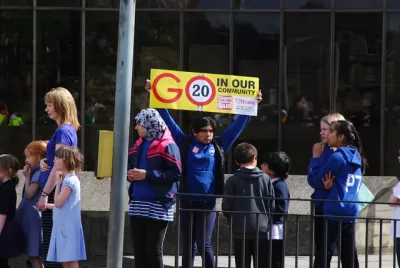
"Seattle City Councilmembers Tim Burgess and Mike O’Brien announced a proposal to lower speed limits throughout much of the City of Seattle to limits currently found throughout every other city in King County," reports Ryan Packer.
The proposal would "lower the unsigned speed limit on all non-arterial neighborhood streets" throughout the city to 20 mph and lower the speed limit on center city streets to 25 mph. Packer notes that the change would be a significant gesture toward the city's stated Vision Zero goals of eliminating traffic fatalities and serious injuries by 2030. "Previous moves that the Seattle Department of Transportation (SDOT) has made in pursuit of this goal include the restriction of right turns on red on some problem intersections in Downtown, as well as highly visible distracted driving and anti-DUI campaigns that focus on the personal responsibility aspect of traffic safety," adds Packer.
Read the full story: Vision Zero To Be Propelled By Speed Limit Changes

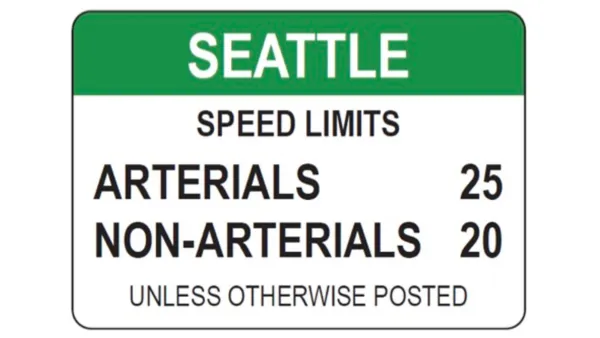
Lower Speed Limits Are the Law in Seattle
The city of Seattle moved quickly in enacting a speed limit change on streets around downtown. File this under real change to achieve the goals of Vision Zero.
Speed Limit Reform Spreading Across Minnesota
After the Twin Cities lowered speed limits in the urban core of the region in 2020, a trio of suburban cities are planning to follow. Two of the cities are planning to set some speed limits as low as 20 mph.
Seattle Expands Speed Limit Reductions
After an initial wave of speed limit reductions in 2016, the city of Seattle will embark on a major expansion of speed limit reductions over the next 18 months.

Planetizen Federal Action Tracker
A weekly monitor of how Trump’s orders and actions are impacting planners and planning in America.

Amtrak, CN end decades-long dispute with eight-year agreement
The new operating agreement establishes an updated framework for the companies to work together, including processes to resolve disputes.

Judges permit Denver to divert 77,000 acre feet from the Colorado River for reservoir expansion
Overuse and climate change have caused the Colorado River’s water levels to plummet.

NYC DOT wants faster, more permanent street upgrades
The city is examining ways to build more concrete infrastructure without getting entangled in 'decades-long' projects.

'Something we’ve never seen before:' rising utility rates could strain city finances nationwide
Data centers, climate change and other factors have caused utility rates in the United States to increase by 38% since 2020.

Trump to overrule local leaders, lease millions of acres of America’s Pacific Island territories’ seafloors to mining companies
International law says that the Indigenous people of America’s territories have a right to prior and informed consent regarding projects that impact their countries.

FREE Course: Walkable City 1: Why Walkability?
After describing his path towards focusing on walkability as the essence of good planning, Jeff Speck marches through his five principal reasons for making more walkable places.
Reinventing Malls: Planning Alchemy—Turning Gray Fields Into Gold
The course focuses on the opportunities and imperatives that shape reinvention of mall sites.

Harvard University Graduate School of Design
KFH Group Inc.
Greater Baltimore Committee
The Architects Foundation
University of Cincinnati Online
The Pocatello Development Authority
The Urban Renewal Agency of the City of Pocatello