Zillow has released research on how many of the nation's homes may be underwater (literally) by the year 2100. Florida, Hawaii, New Jersey, and Louisiana are at the highest risk.


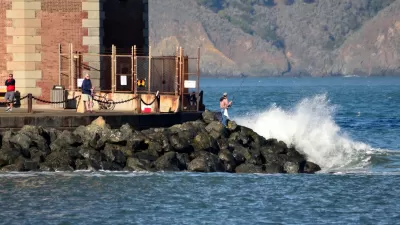
In an attempt to quantify the effect of climate change on housing supply, Zillow has compiled data on how many structures will likely be in danger by the year 2100, if not sooner.
Krishna Rao writes, "To quantify the impact of rising sea levels, we used maps released by the National Oceanic and Atmospheric Administration (NOAA) showing which parts of coastal states will be underwater if sea levels rise by six feet. Why six feet? Some estimates suggest sea levels will rise that much by the year 2100 if climate change continues unchecked."
"Nationwide, almost 1.9 million homes (or roughly 2 percent of all U.S. homes) – worth a combined $882 billion – are at risk of being underwater by 2100. And in some states, the fraction of properties at risk of being underwater is alarmingly high." The coastal homes at risk are worth significantly more than the American average: about $300,000 to the average $187,000.
The article includes a sobering chart showing estimates of how many properties may be affected by 2100, their combined value on the current market, and what fraction of the state's total housing stock they represent. There are also maps of individual cities with potentially flooded areas marked in blue.
FULL STORY: Climate Change and Housing: Will a Rising Tide Sink all Homes?

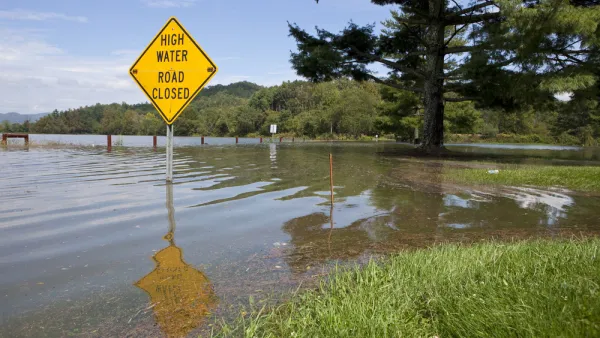
Welcome to a Changed Climate: It Even Floods When it's Sunny
A new report by the National Oceanic and Atmospheric Administration documents the increasing frequency of nuisance floods and "clear-sky flooding."
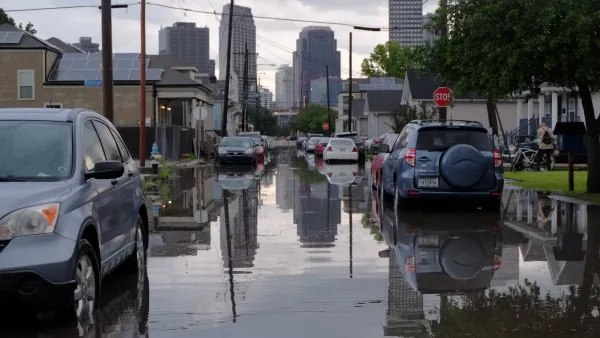
Study: New Orleans sea level rise is at 'point of no return'
Research shows that the city could be surrounded by water by the end of this century.
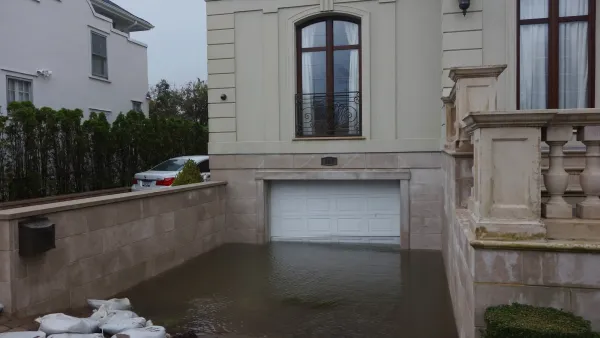
Over 500 NYC ‘Blue Zones’ at Risk of More Destructive Floods
High-risk flood zones cover roughly 20% of the city’s land.

The state-sanctioned urbicide of Austin
People don’t kill cities. Freeways do.

US to reduce Colorado River water deliveries to Mexico
A new Colorado Treaty amendment reduces Mexico’s Colorado River water allocation by 250,000 acre feet.

New Jersey’s second-largest city bans standalone data centers
Jersey City will continue to allow co-location facilities, such as those meant for research institutions that store their own data.

Amtrak not solely to blame for New Jersey commuter rail's unreliability, report finds
A new study from the Garden State Initiative found that NJ Transit’s budget grew 20% across a 4 year period, but reliability declined significantly over the same period.

EPA erases limits on planet-warming pollution from power plants
Under Monday’s plan, power plants would still have some limits on how much mercury, arsenic and other contaminants they can emit.

Phoenix announces new on-demand transit service, more frequent RAPID buses
Both new services will launch in October, and are part of Phoenix's Project Effective Access Solutions for Easing Congestion.

FREE Course: Walkable City 1: Why Walkability?
After describing his path towards focusing on walkability as the essence of good planning, Jeff Speck marches through his five principal reasons for making more walkable places.
Reinventing Malls: Planning Alchemy—Turning Gray Fields Into Gold
The course focuses on the opportunities and imperatives that shape reinvention of mall sites.

Eagle County Government
Harvard University Graduate School of Design
Nashville Planning Department
The Architects Foundation
University of Cincinnati Online
The Pocatello Development Authority
The Urban Renewal Agency of the City of Pocatello
Journal of the American Planning Association