Decades ago, developers installed sub-standard asphalt on residential streets in Omaha, with the understanding that residents, not the city, would maintain them.


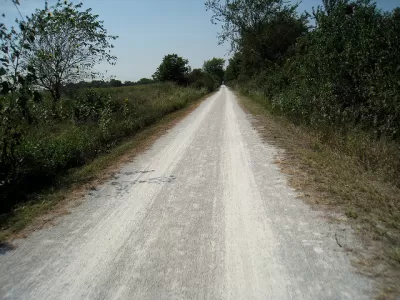
The Associated Press tells the story of a controversy roiling the city of Omaha, where the city recently unpaved roads, leaving only dirt roads, on miles of its residential streets. About 10,000 houses now line the dirt roads, and residents aren't happy.
The article traces the roots of the controversy (an agreement between the city and developers many decades ago) and the public outrage over the current condition of the city's streets.
Meanwhile, the city and neighborhood groups still have yet to find the funding to cover the estimated $300 million bill to fix all the substandard streets in Omaha.
The whole story serves as another example, with a twist, naturally, on a trend gaining strength around the country, where towns and cities are un-paving roads as an austerity measure.
Read the full story: City of Omaha bulldozes pothole-filled street after complaints, residents still complaining about new dirt road

The Latest Trend in Transportation Infrastructure: Un-Paving Roads
A recent study discovered that towns and cities around the country had removed the pavement on thousands of roads in the last five years.
Study: Pavement covers 40% of Phoenix
A new study reveals how ultrafine particles emitted by pavement worsen air quality.
Omaha's 400 shared e-bikes are now free to all residents
Before eliminating fares for locals, the Heartland system only recovered 10%-15% of its operating costs through fare revenue.

Planetizen Federal Action Tracker
A weekly monitor of how Trump’s orders and actions are impacting planners and planning in America.

Amtrak, CN end decades-long dispute with eight-year agreement
The new operating agreement establishes an updated framework for the companies to work together, including processes to resolve disputes.

Judges permit Denver to divert 77,000 acre feet from the Colorado River for reservoir expansion
Overuse and climate change have caused the Colorado River’s water levels to plummet.

How ‘post-disaster gentrification’ alters neighborhoods after natural calamities
After hurricanes, fires or other calamities, the original residents of a community are often replaced by younger, wealthier residents.

Maryland local governments examine if they should have more power to raise property taxes
Maryland’s housing market is out of reach for the majority of moderate-income residents.

Northwest rail fans eager for Sept. 30 debut of Amtrak’s Airo fleet
Get ready for that new train smell and more seats. But they won’t go faster or run more frequently on the Cascades route in Washington and Oregon.

FREE Course: Walkable City 1: Why Walkability?
After describing his path towards focusing on walkability as the essence of good planning, Jeff Speck marches through his five principal reasons for making more walkable places.
Reinventing Malls: Planning Alchemy—Turning Gray Fields Into Gold
The course focuses on the opportunities and imperatives that shape reinvention of mall sites.

Harvard University Graduate School of Design
KFH Group Inc.
Greater Baltimore Committee
The Architects Foundation
University of Cincinnati Online
The Pocatello Development Authority
The Urban Renewal Agency of the City of Pocatello