How cities around the world have approached thinking about how water management fits in to urban planning.



What does "design with water" mean? To Vincent Lee, Associate Principal and Technical Director for Water at ARUP, it is "a framework for rethinking the place of water in the urban design process, and putting it back at the heart of the design process for the built environment."
In The Planning Report, Lee explains that the design strategy of "blue-green" infrastructure, which addresses not just water or energy use, but also the inherent connections between two. Lee explains how places like Seoul, South Korea; Cardiff, Wales; and New York City have leveraged blue-green infrastructure.
Lee's overall message is simple:
"Implement not just green infrastructure and green design, but blue-green infrastructure and blue-green design."
Lee also shared lessons and related global works to undertakings in progress. In one example, Lee related the work of Seoul’s Cheonggyecheon stream restoration to the Los Angeles River, explaining that there is tremendous potential for the river to become a revitalized area that has a restored ecosystem. The Cheonggyecheon stream restoration has increased biodiversity, reduced air pollution by 35 percent, and reduced the heat island effect by up to 5.9 degrees Celsius within surrounding city blocks.
In talking about lessons he has learned over his career, Lee shares the hope he finds from residents and collaborators who are trying to do something different. He describes the "power of the citizen" in shaping New York City's High Line area, and the success of Rotterdam in adapting to climate impacts by having agencies think about working together.
Read more of Vincent Lee's "green-blue" tour around the world in The Planning Report.
Read the full story: The ‘Place’ of Water in Urban Design: ARUP's Vincent Lee
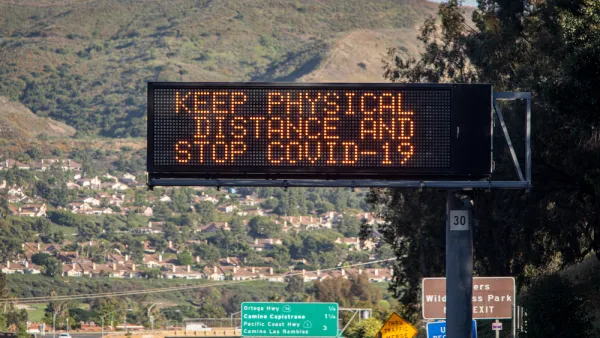
Second Anniversary of the COVID-19 Pandemic
March 11 marked the second anniversary of WHO's declaration of the pandemic and the beginning of its third year. Cases continue to plummet in the U.S. and plateau globally while war in Europe has overshadowed the virus that has killed 6 million.
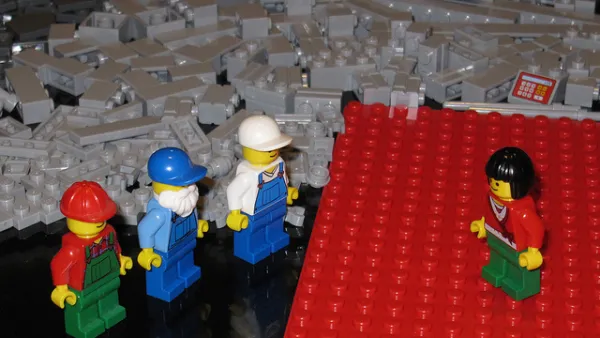
The World's Largest Modular Building: Now Leasing in Brooklyn
Modular construction has been offered as a cheaper construction alternative and a possible solution for the affordable housing crisis. Now the building typology has a new showcase project in Brooklyn.
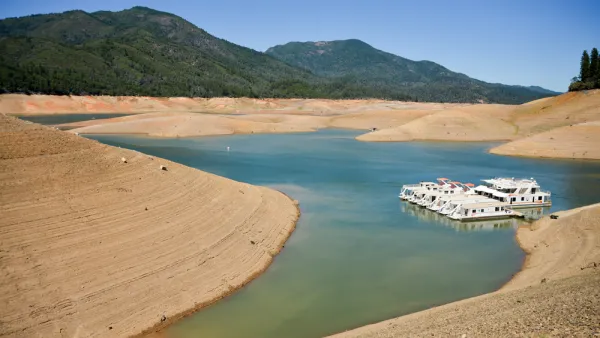
Climate Change Requires a Different Paradigm for California's Water Supply
Jeff Kightlinger, general manager of the Metropolitan Water District of Southern California, explains how the impacts of California’s historic drought are already changing the landscape of the American Southwest.

Planetizen Federal Action Tracker
A weekly monitor of how Trump’s orders and actions are impacting planners and planning in America.

California plans to bury El Niño’s downpour
If the state plays its cards right, it may be able to store a billion acre-feet of El Niño’s water in aquifers.

Desperate measures: Advocates weigh draining Lake Powell to fill Colorado River
Draining the reservoir could reduce evaporation losses by a couple hundred thousand acre-feet.

Los Angeles just elected an urban planner as its mayor
Transportation analysts are optimistic that Raman will be more aggressive in addressing transit issues than Bass.

Mamdani’s pied-à-terre tax survives legal challenge
A panel of judges found that the plaintiffs failed to demonstrate injury as a result of New York City's implementation of the tax.

Eastern Nebraska is running out of electricity
Data centers and electrification are straining eastern Nebraska’s grid, throttling economic development.

FREE Course: Walkable City 1: Why Walkability?
After describing his path towards focusing on walkability as the essence of good planning, Jeff Speck marches through his five principal reasons for making more walkable places.
Reinventing Malls: Planning Alchemy—Turning Gray Fields Into Gold
The course focuses on the opportunities and imperatives that shape reinvention of mall sites.

City of Rosemead
Rutgers University, Edward J. Bloustein School of Planning and Public Policy
One Hundred Miles
University of Michigan School for Environment and Sustainability (SEAS)
Hunter College, City University of New York (CUNY)
The Architects Foundation
City of Cambridge
Montrose County
The Pocatello Development Authority