A media blitz scheduled for June 29, 2016 will offer an unprecedented display of "solutions-oriented journalism."



Thomas Fuller reports: "Next month, media organizations in the Bay Area are planning to put aside their rivalries and competitive instincts for a day of coordinated coverage on the homeless crisis in the city."
The San Francisco Chronicle is leading the effort, but representatives from Bay Area television and radio stations, The San Francisco Examiner, Mother Jones, and online publications are included among the media outlets planning the effort. All told, 30 new organizations have confirmed their participation. "The premise of the effort is to create a 'wave' of coverage that will force politicians to come up with solutions," according to Audrey Cooper, the editor in chief of the San Francisco Chronicle, who is quoted extensively in the article.
Fuller is careful to document the collaboration's conceptual problem of crossing the line into "solutions-oriented journalism." Apparently, the idea of using the collaborative effort to propose new solutions encountered very little dissension as the participating groups planned the effort.
Mark you calendars for the big reveal of this unprecedented coordination of journalistic resources, the blitz of coverage on homelessness is scheduled for June 29.
Read the full story: A Plan to Flood San Francisco With News on Homelessness
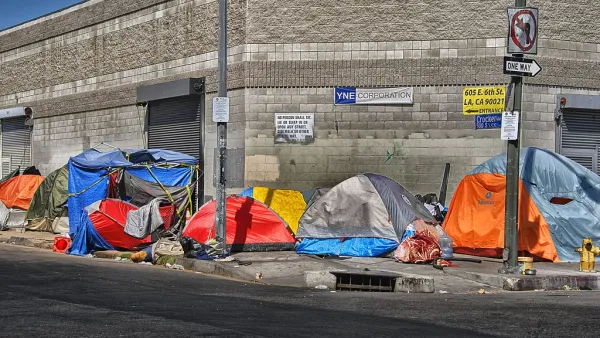
Homelessness Fuels a Backlash in California
The Golden State's ongoing homelessness crisis has residents on edge and is testing the limits of empathy in a state known for its liberal values.

Op-Ed: Only Half of San Francisco is Changing
Using a mid 20th-century painting as his point of reference, Benjamin Schneider points out that the vast, disruptive changes we often associate with San Francisco are only affecting the city's eastern side.

Will More Money Solve San Francisco's Homelessness Problem?
San Francisco voters will decide on Proposition C, a business tax based on gross receipts levied on large employers, the most contentious of five local measures.

Planetizen Federal Action Tracker
A weekly monitor of how Trump’s orders and actions are impacting planners and planning in America.

California plans to bury El Niño’s downpour
If the state plays its cards right, it may be able to store a billion acre-feet of El Niño’s water in aquifers.

Desperate measures: Advocates weigh draining Lake Powell to fill Colorado River
Draining the reservoir could reduce evaporation losses by a couple hundred thousand acre-feet.

Mamdani’s pied-à-terre tax survives legal challenge
A panel of judges found that the plaintiffs failed to demonstrate injury as a result of New York City's implementation of the tax.

Eastern Nebraska is running out of electricity
Data centers and electrification are straining eastern Nebraska’s grid, throttling economic development.

Seattle passes record-breaking transit services expansion
Proposition 1 will double the city’s transit tax to add 95,000 more bus trips and preserve 180,000 bus trips annually.

FREE Course: Walkable City 1: Why Walkability?
After describing his path towards focusing on walkability as the essence of good planning, Jeff Speck marches through his five principal reasons for making more walkable places.
Reinventing Malls: Planning Alchemy—Turning Gray Fields Into Gold
The course focuses on the opportunities and imperatives that shape reinvention of mall sites.

City of Rosemead
Rutgers University, Edward J. Bloustein School of Planning and Public Policy
One Hundred Miles
University of Michigan School for Environment and Sustainability (SEAS)
Hunter College, City University of New York (CUNY)
The Architects Foundation
City of Cambridge
Montrose County
The Pocatello Development Authority