Leslie Koch, the president and chief executive of the Trust for Governors Island, in the Hills on Thursday. After leading the trust for a decade, she is announcing her retirement.


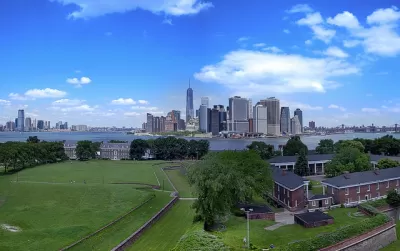
Matt A.V. Chaban reports on the forthcoming culmination of an ongoing project to remake Governors Island in New York, and the woman behind it all.
First, a description of the big day for Governors Island, coming this summer:
At 10 a.m. on July 19, the final section of Governors Island, known as the Hills, will open to the public. Some 10 acres of ridges, paths, slides and lawns will rise seven stories over the harbor, providing panoramic views of New York City.
The Hills is the final piece in the ongoing effort to remake Governors Island:
The island, and its 139 acres of parkland, will open on Memorial Day this year, as it has for the past decade. But the ambition is for it to become a year-round destination with “millions of new square feet for commerce, culture, and research,” as Mayor Bill de Blasio put it during his State of the City speech in February.
With the park complete, so too will be the work of Leslie Koch, the president and chief executive of the Trust for Governors Island, who recently announced her retirement. According to Chaban, "everywhere you look on Governors Island, you see Ms. Koch’s influence." The article includes a detailed account of Koch's achievements in addition to the concepts that drove the revitalization of Governors Island during her career.
Read the full story: As the Revival of Governors Island Reaches a Peak, Its Architect Steps Down

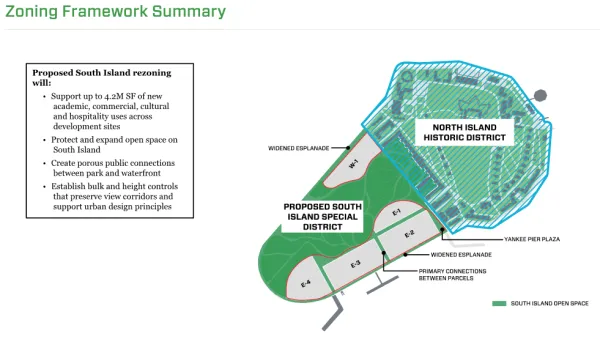
Rezoning for Governors Island Approved
A mix of new development focused on future needs and new tools for preservation are included in the rezoning package for the south end of Governors Island approved by the New York City Council in May.
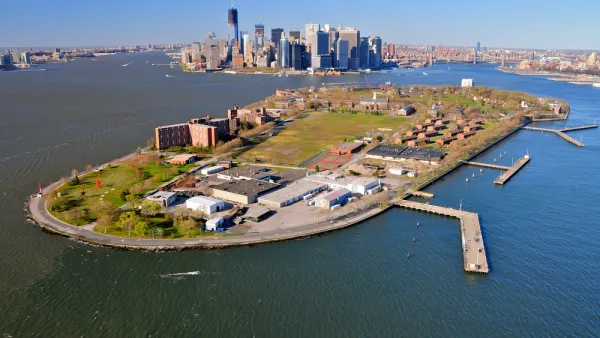
Massive Climate Research Center Planned for Governors Island, Rezoning Now Included
A speculative but exceedingly ambitious plan is pressing for air time in New York City.
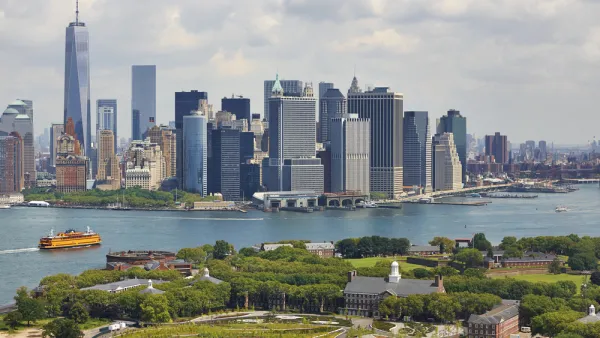
Proposal for the Future of New York's Governors Island
The island's 40-acre park is a recreational destination, but waterfront advocates would like to see more use of Governor Island's shoreline and maritime infrastructure.

Planetizen Federal Action Tracker
A weekly monitor of how Trump’s orders and actions are impacting planners and planning in America.

Amtrak, CN end decades-long dispute with eight-year agreement
The new operating agreement establishes an updated framework for the companies to work together, including processes to resolve disputes.

Judges permit Denver to divert 77,000 acre feet from the Colorado River for reservoir expansion
Overuse and climate change have caused the Colorado River’s water levels to plummet.

Boston has spent millions making the Green Line more accessible — and there’s no end in sight
While the city has invested millions into expanding and adding platforms to the Green Line to make it more accessible, new train cars set to arrive next year will be too tall for disabled passengers to board without raising the current platforms.

Idaho may see an 18% drop in federal surface transit funding — the largest estimated cut in the US
Transit systems in rural communities are much more reliant on federal funding to provide their services.

How ‘post-disaster gentrification’ alters neighborhoods after natural calamities
After hurricanes, fires or other calamities, the original residents of a community are often replaced by younger, wealthier residents.

FREE Course: Walkable City 1: Why Walkability?
After describing his path towards focusing on walkability as the essence of good planning, Jeff Speck marches through his five principal reasons for making more walkable places.
Reinventing Malls: Planning Alchemy—Turning Gray Fields Into Gold
The course focuses on the opportunities and imperatives that shape reinvention of mall sites.

City of Wisconsin Rapids
Harvard University Graduate School of Design
KFH Group Inc.
The Architects Foundation
University of Cincinnati Online
The Pocatello Development Authority
The Urban Renewal Agency of the City of Pocatello