The debate over the impacts of parking isn't new, but San Francisco planners are hoping that their approach to parking will provide new mobility solutions in a growing city.


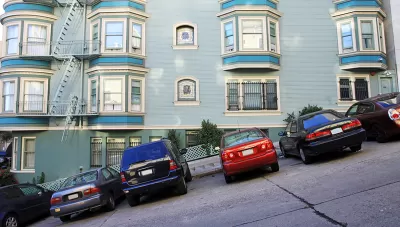
John Cote details the efforts of San Francisco to implement a new approach to parking as the city tackles an explosion of growth in the 21st century. First, Cote describes the problem:
This information comes as San Francisco is in the midst of one of its biggest new-housing construction booms in history, projected to add 100,000 households and more than 190,000 new jobs by 2040. If everyone arrives with a car, that’s going to be a recipe for gridlock and economic stagnation. The effects on the environment, quality of life and pedestrian safety will be substantial. The city will grind to a halt.
After noting that research proves that parking induces driving, Cote describes how planners are acting as if parking will exacerbate those problems, rather than providing any solutions. The city's primary planning effort focused on new solutions to the mobility challenges of the future is the Transportation Sustainability Program—a three-part program "designed to invest more in our transportation system, align our environmental rules with policy goals like emissions reductions and smart growth along transit, and shift choices to makes it easier for people to get around by transit, walking, biking, or carsharing," explains Cote.
Read the full story: The Growing Case for a New Approach to SF's Parking Problem
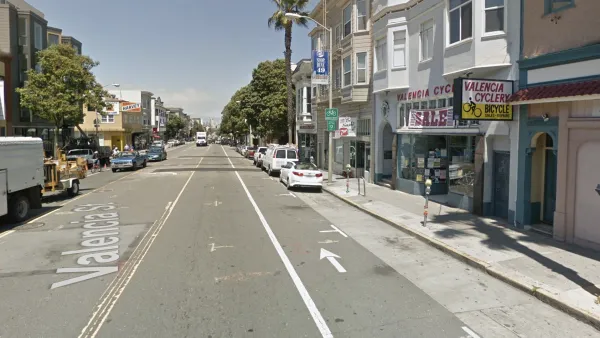
Latest San Francisco Bike Battlefront: Valencia Street
With most private auto traffic banned on Market Street in downtown, a battle is brewing in the Mission District between Valencia Street merchants, led by a bike store owner, and cyclists who support converting a bike lane into a cycletrack.
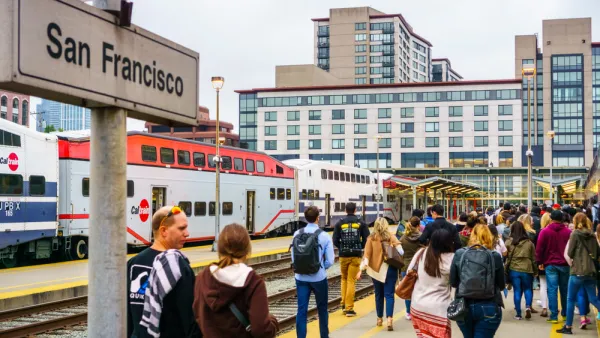
'100-Year Decision': First Approval for Train Route to S.F.'s Salesforce Transit Center
John Rahaim, director of the San Francisco Planning Department, calls the decision to route Caltrain to the newly opened Salesforce Transit center a "100-year decision."
More Details of Bus Rapid Transit's Expanding Reach in San Francisco
The Geary bus corridor was the #1 pick for a subway according to a Muni survey, but commuters will have to settle for bus rapid transit. A milestone was reached when the San Francisco County Transportation Authority approved the design and EIR.

Planetizen Federal Action Tracker
A weekly monitor of how Trump’s orders and actions are impacting planners and planning in America.

California plans to bury El Niño’s downpour
If the state plays its cards right, it may be able to store a billion acre-feet of El Niño’s water in aquifers.

Desperate measures: Advocates weigh draining Lake Powell to fill Colorado River
Draining the reservoir could reduce evaporation losses by a couple hundred thousand acre-feet.

Mamdani’s pied-à-terre tax survives legal challenge
A panel of judges found that the plaintiffs failed to demonstrate injury as a result of New York City's implementation of the tax.

Eastern Nebraska is running out of electricity
Data centers and electrification are straining eastern Nebraska’s grid, throttling economic development.

Seattle passes record-breaking transit services expansion
Proposition 1 will double the city’s transit tax to add 95,000 more bus trips and preserve 180,000 bus trips annually.

FREE Course: Walkable City 1: Why Walkability?
After describing his path towards focusing on walkability as the essence of good planning, Jeff Speck marches through his five principal reasons for making more walkable places.
Reinventing Malls: Planning Alchemy—Turning Gray Fields Into Gold
The course focuses on the opportunities and imperatives that shape reinvention of mall sites.

City of Rosemead
Rutgers University, Edward J. Bloustein School of Planning and Public Policy
One Hundred Miles
University of Michigan School for Environment and Sustainability (SEAS)
Hunter College, City University of New York (CUNY)
The Architects Foundation
City of Cambridge
Montrose County
The Pocatello Development Authority