Orange County, California transportation officials want to widen the 405 to reduce travel times and ease predicted congestion. The cities of Seal Beach and Long Beach are concerned about how that will impact traffic on surface streets.


Erika Aquilar reports on the latest news in an ongoing legal battle between the state of California and two cities in Southern California. The cities of Long Beach and Seal Beach sued the California Department of Transportation in 2015 "over plans to add one toll lane and one free lane to the 405 between State Route 73 in Costa Mesa and the 605 Freeway near the Los Angeles County line. The proposal also calls for converting the existing carpool lane into a toll lane."
The cities are concerned that the new freeway capacity will spill new traffic onto their surface streets, so "they want Caltrans and the Orange County Transportation Authority to pay for more traffic congestion solutions on city surface streets," according to Aguilar.
The cities believe that if Caltrans widens the final stretch of I-405 in Orange County, the additional traffic will spill onto surface streets when it hits a bottleneck at the Los Angeles County line. Orange County Transportation Authority is pitching the project as needed congestion relief.
Drive times on the 405 between SR-73 and the 605 are projected to take more than an hour by the year 2040 but, according to the OCTA, with the additional free lane, that commute could be cut in half; and up to 13 minutes if a driver chooses to pay for the toll lanes.
Aguilar also covered the controversy before Long Beach took legal action in 2015.
FULL STORY: Legal fight over the 405 expansion in Orange County moves to San Diego

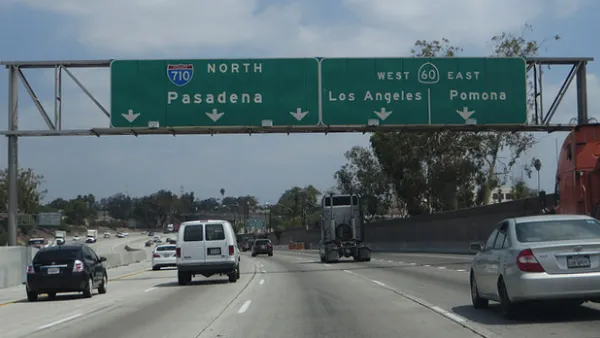
A Traffic Solution 'Straight Out of the 1950s'
That's how the Los Angeles Times editorial board characterized the $6 billion plan by Los Angeles Metro to widen the 710 freeway. "A waste of money," they assert. Key to the solution is how to deal with goods movement from the seaport complex.
Caltrans Overrides OCTA: 405 Freeway Widening Must Include Toll Lane
Transportation decisions are best made locally, not by the state DOT, right? For those advocating for tolled, managed lanes over free, general purpose lanes, the 405 Freeway in Orange County may prove the exception.
User Fees and Sales Tax Dollars Finance $1.9 Billion Four-Lane Freeway Widening
A 16-mile express lane and general purpose lane will be added in each direction of the San Diego Freeway in Orange County. A $629 million TIFIA loan will be repaid by toll-paying motorists, while all taxpayers pay most of the remainder.

Planetizen Federal Action Tracker
A weekly monitor of how Trump’s orders and actions are impacting planners and planning in America.

The state-sanctioned urbicide of Austin
People don’t kill cities. Freeways do.

US to reduce Colorado River water deliveries to Mexico
A new Colorado Treaty amendment reduces Mexico’s Colorado River water allocation by 250,000 acre feet.

Mamdani overhauls NYC's Vision Zero plan with 100 new policy goals
The overhaul aims to reduce traffic deaths and make streets safer for pedestrians, cyclists and drivers through lower speed limits, new safety infrastructure and more.

Amtrak not solely to blame for New Jersey commuter rail's unreliability, report finds
A new study from the Garden State Initiative found that NJ Transit’s budget grew 20% across a 4 year period, but reliability declined significantly over the same period.

EPA erases limits on planet-warming pollution from power plants
Under Monday’s plan, power plants would still have some limits on how much mercury, arsenic and other contaminants they can emit.

FREE Course: Walkable City 1: Why Walkability?
After describing his path towards focusing on walkability as the essence of good planning, Jeff Speck marches through his five principal reasons for making more walkable places.
Reinventing Malls: Planning Alchemy—Turning Gray Fields Into Gold
The course focuses on the opportunities and imperatives that shape reinvention of mall sites.

Eagle County Government
Harvard University Graduate School of Design
Nashville Planning Department
The Architects Foundation
University of Cincinnati Online
The Pocatello Development Authority
The Urban Renewal Agency of the City of Pocatello
Journal of the American Planning Association