The organization 100 Resilient Cities has funded 'chief resilience officers' in 66 cities worldwide. It's helping four California cities prepare for 'stresses and shocks' including earthquakes, sea level rise, and even poverty.


"'Resilience' refers to cities’ ability to weather and recover from discrete 'shocks,' such as earthquakes, and chronic 'stresses,' such as poverty and the predicted effects of climate change. California has become Ground Zero in the resilience movement."
"Once defined, 100RC encourages each city to set its own priorities, by identifying its most pressing threats and the strategies needed to avoid or recover from them. Likewise, cities identify initiatives already underway and might reframe then as resilience-building efforts. 100RC bases its approach to resilience on the “City Resilience Framework,” drafted in a multi-year process by ARUP. The framework is accompanied by an index of 200 indicators of urban resilience."
"Regardless of how much support or funding they have, CROs may not be around long enough to witness the fruits of their labors (or to witness the non-events that will take place when cities weather disasters). 100RC hopes that cities will continue to fund CRO positions after two- or three-year grant periods. But cities are not obligated to do so. For that reason, the project has been criticized as encouraging cities to 'make plans to make plans.'"
Read the full story: California Cities Join Global Urban Resilience Movement

Report Outlines Strategies for Resilient Wildfire Recovery in LA
Project Recovery offers a roadmap for rebuilding more sustainable and climate-resilient communities after wildfires and other disasters.
Sustainability Expert Becomes Dean of USC’s School of Public Policy
Chris Boone, a sustainability leader, becomes dean of the USC Price School of Public Policy, where he aims to advance interdisciplinary solutions and sustainability initiatives while building on the school’s legacy of public policy leadership.
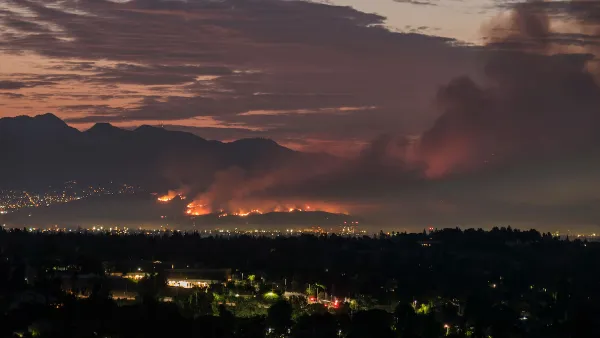
Significant Investments Needed to Protect LA County Residents From Climate Hazards
A new study estimates that LA County must invest billions of dollars before 2040 to protect residents from extreme heat, increasing precipitation, worsening wildfires, rising sea levels, and climate-induced public health threats.

Planetizen Federal Action Tracker
A weekly monitor of how Trump’s orders and actions are impacting planners and planning in America.

California plans to bury El Niño’s downpour
If the state plays its cards right, it may be able to store a billion acre-feet of El Niño’s water in aquifers.

Desperate measures: Advocates weigh draining Lake Powell to fill Colorado River
Draining the reservoir could reduce evaporation losses by a couple hundred thousand acre-feet.

Housing is the top priority of Seattle’s sole new councilmember
Jenks campaigned on building 1,000 new units of affordable housing.

New tax cuts may slash $1.5 billion in funding for Miami transit, public parks
Amendment 3 will save Miami-Dade homeowners $2,700 in 2028.

Arizona, Wisconsin, Pennsylvania hope to finally advance climate goals post-midterms
The three states have spent years under Republican or divided control.

FREE Course: Walkable City 1: Why Walkability?
After describing his path towards focusing on walkability as the essence of good planning, Jeff Speck marches through his five principal reasons for making more walkable places.
Reinventing Malls: Planning Alchemy—Turning Gray Fields Into Gold
The course focuses on the opportunities and imperatives that shape reinvention of mall sites.

City of Rosemead
Rutgers University, Edward J. Bloustein School of Planning and Public Policy
One Hundred Miles
University of Michigan School for Environment and Sustainability (SEAS)
Hunter College, City University of New York (CUNY)
The Architects Foundation
City of Cambridge
Montrose County
The Pocatello Development Authority