It's not a done deal yet, but Norway's $1 billion plan for inter-city bicycle highways should be enough to inspire envy among cyclists here in the United States.



Norway is considering a plan to "spend a massive 8 billion Norwegian Kroner ($923 million) creating 10 broad, two-lane, cross-country bike tracks in and near Norway’s nine largest cities," reports Feargus O'Sullivan.
O'Sullivan provides more details about the proposed bicycle highways:
In keeping with the emerging European definition of the term “bike highway” (“super cycleway” in Norwegian), these will not be tracks linking far-flung cities across hundreds of miles, at least not at this initial stage. What the new paths will do is create bike commuter links between inner cities and outer suburbs, extending the protected cycle network out from urban cores through the commuter belt and into the countryside beyond.
The bike highway plans are a component of the country's emissions reductions strategy, but the project will still have to jump through political hoops for approval and overcome substantial geographic obstacles to the casual adoption of biking. O'Sullivan provides a description of all of these realities, as well as an introduction to the country's larger plans for transportation, in the article.
For other examples of European countries building inter-city bike infrastructure, see an article from January about the progress of Germany's "bike autobahn."
Read the full story: Norway Will Spend Almost $1 Billion on New Bike Highways

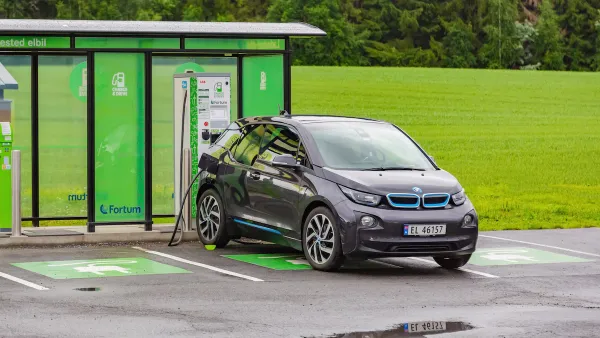
Norway’s EV Boom Could Entrench Car Dependency
The Scandinavian country is a pioneer when it comes to EV adoption, but there are downsides.

Rationing Energy
American motorists may complain about the 'pain at the pump,' but there is no shortage of gasoline, unlike the availability of natural gas in Europe.
The Pandemic Is Not Ending—But Restrictions Are
The science hasn't changed but the politics have, and policymakers are responding appropriately. Transmission of the coronavirus during the Omicron wave remains at an all-time high, although infections are decreasing globally.

Planetizen Federal Action Tracker
A weekly monitor of how Trump’s orders and actions are impacting planners and planning in America.

Amtrak, CN end decades-long dispute with eight-year agreement
The new operating agreement establishes an updated framework for the companies to work together, including processes to resolve disputes.

Judges permit Denver to divert 77,000 acre feet from the Colorado River for reservoir expansion
Overuse and climate change have caused the Colorado River’s water levels to plummet.

Idaho may see an 18% drop in federal surface transit funding — the largest estimated cut in the US
Transit systems in rural communities are much more reliant on federal funding to provide their services.

How ‘post-disaster gentrification’ alters neighborhoods after natural calamities
After hurricanes, fires or other calamities, the original residents of a community are often replaced by younger, wealthier residents.

Maryland local governments examine if they should have more power to raise property taxes
Maryland’s housing market is out of reach for the majority of moderate-income residents.

FREE Course: Walkable City 1: Why Walkability?
After describing his path towards focusing on walkability as the essence of good planning, Jeff Speck marches through his five principal reasons for making more walkable places.
Reinventing Malls: Planning Alchemy—Turning Gray Fields Into Gold
The course focuses on the opportunities and imperatives that shape reinvention of mall sites.

Harvard University Graduate School of Design
KFH Group Inc.
Greater Baltimore Committee
The Architects Foundation
University of Cincinnati Online
The Pocatello Development Authority
The Urban Renewal Agency of the City of Pocatello