Bike advocates have high hopes for the leadership of newly elected Philadelphia Mayor Jim Kenney. Among Mayor Kenney's campaign promises: to add 30 miles of protected bike lanes.


Michael Andersen describes the potential bike infrastructure benefits that could come from the new mayoral administration in Philadelphia. First, however, Andersen provides some context about Philadelphia's well-earned, but perhaps sagging, status as the most bike-friendly large city in the country. According to Andersen, "over the last few years, a second city — Chicago — has been making a dash for Philadelphia's longtime status as the country's bikingest city of more than 1 million." Chicago has achieved gains in bike ridership by "installing one of the country's best-connected networks of buffered and protected bike lanes in its downtown and central neighborhoods."
Now, however, "Philadelphia's new mayor has taken a page from Chicago's book. In the run-up to his landslide victory last May, Jim Kenney pledged [pdf] to build 30 miles of protected bike lanes in the next five years."
All indications so far are that Mayor Kenney intends to follow through on that pledge. One sign of good faith already: earlier this month Mayor Kinney's office announced the creation of the city's new Office of Complete Streets, which comes complete with a "Complete Streets Commissioner." In addition to that support in City Hall, Andersen suggests that local bike advocacy organizations will also lend plenty of help in seeing the goal of 30 miles of protected bike lanes come to fruition. "Last month, the Bicycle Coalition released its own proposal for where to put 30 miles of protected bike lanes around the city," reports Andersen, "most prominently with a JFK/Market couplet through the heart of downtown."
FULL STORY: PHILADELPHIA’S NEW MAYOR PLEDGES 30 MILES OF PROTECTED BIKE LANES IN FIVE YEARS

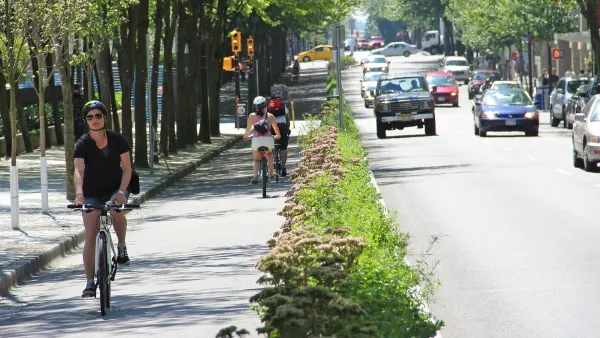
Protected Bike Lanes Deliver Numerous Benefits, Study Says. But Is it Enough to Change State Law?
Advocates in Philadelphia are pushing state lawmakers to finally pass a law to make it easier to install protected bike lanes on state routes.
Why a Complete Streets Makeover Went Awry in Philadelphia
The city pulled the plug on a proposed street redesign after community groups criticized the public engagement process for not listening to all local voices.
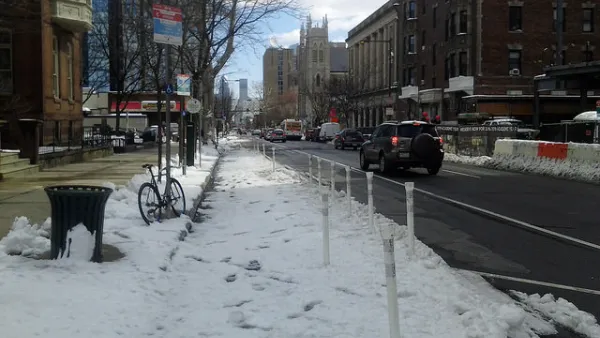
Philadelphia Advocates Sue for Protected Bike Lane
As the city continues to make little progress on planned bike lanes, cyclists are turning to the courts for relief.

Planetizen Federal Action Tracker
A weekly monitor of how Trump’s orders and actions are impacting planners and planning in America.

The state-sanctioned urbicide of Austin
People don’t kill cities. Freeways do.

US to reduce Colorado River water deliveries to Mexico
A new Colorado Treaty amendment reduces Mexico’s Colorado River water allocation by 250,000 acre feet.

Mamdani overhauls NYC's Vision Zero plan with 100 new policy goals
The overhaul aims to reduce traffic deaths and make streets safer for pedestrians, cyclists and drivers through lower speed limits, new safety infrastructure and more.

Amtrak not solely to blame for New Jersey commuter rail's unreliability, report finds
A new study from the Garden State Initiative found that NJ Transit’s budget grew 20% across a 4 year period, but reliability declined significantly over the same period.

EPA erases limits on planet-warming pollution from power plants
Under Monday’s plan, power plants would still have some limits on how much mercury, arsenic and other contaminants they can emit.

FREE Course: Walkable City 1: Why Walkability?
After describing his path towards focusing on walkability as the essence of good planning, Jeff Speck marches through his five principal reasons for making more walkable places.
Reinventing Malls: Planning Alchemy—Turning Gray Fields Into Gold
The course focuses on the opportunities and imperatives that shape reinvention of mall sites.

Eagle County Government
Harvard University Graduate School of Design
Nashville Planning Department
The Architects Foundation
University of Cincinnati Online
The Pocatello Development Authority
The Urban Renewal Agency of the City of Pocatello
Journal of the American Planning Association