Hindsight is 20-20, but so too sometimes is the foresight of geologists. That was the case prior to the flooding that struck St. Louis this December.


Tony Messenger spotlights the example of Washington University geology professor Bob Criss, who several months ago, at a local conference and later in the Journal of Earth Science [pdf], raised alarms that St. Louis was severely underprepared for the flood risk facing the region. Criss argued that "statistical methods used by the U.S. Army Corps of Engineers and the Federal Emergency Management Agency to define flood risk are outdated."
Criss turned out to be right—the Mississippi River flooded towns around St. Louis on Christmas Eve and Christmas Day. Flood warnings continued through December 31, at this time of this writing.
The article presents the "Floods of 2015" as a failure of policy. Criss argues especially against the policies enacted by the Army Corps of Engineers.
Read the full story: Pied Piper of failed river policies saw this coming

Floodplain Development Plugs On in Missouri
Flooding in the Mississippi River floodplain in Missouri caused federal officials to call for the removal of buildings and homes in the threatened area in 1993. But now, development is being allowed in the same flood-prone areas.

Study: Outdated Stormwater Infrastructure Exacerbates Flooding
Infrastructure built to mitigate flooding a century ago no longer serves current needs.
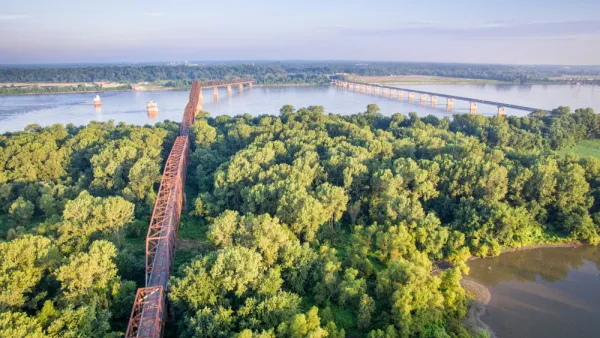
$323 Million Waterfront Project Cruising Along in St. Louis
Lighthouse Point, a $323 million marina and waterfront development proposed for the banks of the Mississippi River, has already been granted a special district, tax abatements, and sales tax exemptions.

Planetizen Federal Action Tracker
A weekly monitor of how Trump’s orders and actions are impacting planners and planning in America.

Amtrak, CN end decades-long dispute with eight-year agreement
The new operating agreement establishes an updated framework for the companies to work together, including processes to resolve disputes.

Judges permit Denver to divert 77,000 acre feet from the Colorado River for reservoir expansion
Overuse and climate change have caused the Colorado River’s water levels to plummet.

NYC DOT wants faster, more permanent street upgrades
The city is examining ways to build more concrete infrastructure without getting entangled in 'decades-long' projects.

'Something we’ve never seen before:' rising utility rates could strain city finances nationwide
Data centers, climate change and other factors have caused utility rates in the United States to increase by 38% since 2020.

Trump to overrule local leaders, lease millions of acres of America’s Pacific Island territories’ seafloors to mining companies
International law says that the Indigenous people of America’s territories have a right to prior and informed consent regarding projects that impact their countries.

FREE Course: Walkable City 1: Why Walkability?
After describing his path towards focusing on walkability as the essence of good planning, Jeff Speck marches through his five principal reasons for making more walkable places.
Reinventing Malls: Planning Alchemy—Turning Gray Fields Into Gold
The course focuses on the opportunities and imperatives that shape reinvention of mall sites.

Harvard University Graduate School of Design
KFH Group Inc.
Greater Baltimore Committee
The Architects Foundation
University of Cincinnati Online
The Pocatello Development Authority
The Urban Renewal Agency of the City of Pocatello