Road diets, whereby the number of traffic lanes are reduced to better accommodate cyclists, can be controversial. But what of the opposite—adding lanes to better accommodate motorists? A cyclist died after such an "improvement." A lawsuit followed.


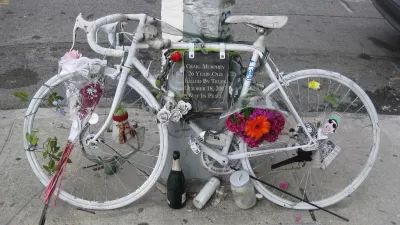
"In June 2012, Dr. Gerald Brett Weiss, a nationally known neurosurgeon, was killed when he was hit from behind while riding his bicycle in the community of Indian Wells [Riverside County], CA," writes Robbie Webber, senior associate at the State Smart Transportation Initiative. "In mid-November of this year his family won a $5.6 million judgment [sic] against Indian Wells, claiming that the city was negligent in not providing sufficient width for bike lanes or lighting that would have prevented the crash."
Never mind that the motorist that killed Dr. Weiss was allegedly drunk, as the city argued. "Experts in court deemed there wasn't enough room in the lane for both the car and the bike, so regardless of alcohol intoxication, the crash was bound to have happened," reports Natalie Brunell for KESQ News. [Video here.]
The roadway had been "expanded from two lanes to three in each direction in 2005, the city did not include a wide outside lane in the design," writes Webber. "In addition, the road previously had bike lanes and was signed as a bike route before the redesign.
Webber's final words are to city transportation planners and engineers:
Governments may want to consider the implications of roadway designs that do not provide safe conditions for all users."
In fact, that's one reason for "complete streets" legislation: to ensure that streets are "designed and operated to enable safe access for all users, including pedestrians, bicyclists, motorists and transit riders of all ages and abilities," according to Smart Growth America.
It's vital to distinguish the "outside," meaning closest to the curb, lane from the inner lanes in terms of lane width. As posted here earlier, it's often preferable to have 10-foot travel lanes over 12-foot inner lanes.
The State Smart Transportation Initiative, housed at the University of Wisconsin, promotes transportation practices that advance environmental sustainability and equitable economic development.
Hat tip to Metro Transportation Library.
Read the full story: California city loses lawsuit after death of bicyclist on road with substandard bike lanes and no lighting

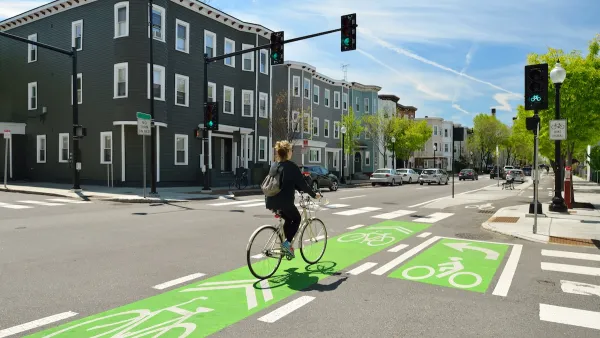
NACTO Releases Updated Urban Bikeway Guide
The third edition of the nationally recognized road design guide includes detailed design advice for roads that prioritize safety and accessibility for all users.
Why a Complete Streets Makeover Went Awry in Philadelphia
The city pulled the plug on a proposed street redesign after community groups criticized the public engagement process for not listening to all local voices.
Austin Businesses Call for Sixth Street Bike Lanes
Local business owners say bike lanes would improve safety and boost local business.

Amtrak, CN end decades-long dispute with eight-year agreement
The new operating agreement establishes an updated framework for the companies to work together, including processes to resolve disputes.

Judges permit Denver to divert 77,000 acre feet from the Colorado River for reservoir expansion
Overuse and climate change have caused the Colorado River’s water levels to plummet.

Nation's most wind-powered state turns to coal as data centers increase energy demand
For the first time in decades, Iowa has increased its generation of coal power.

Boston has spent millions making the Green Line more accessible — and there’s no end in sight
While the city has invested millions into expanding and adding platforms to the Green Line to make it more accessible, new train cars set to arrive next year will be too tall for disabled passengers to board without raising the current platforms.

Idaho may see an 18% drop in federal surface transit funding — the largest estimated cut in the US
Transit systems in rural communities are much more reliant on federal funding to provide their services.

How ‘post-disaster gentrification’ alters neighborhoods after natural calamities
After hurricanes, fires or other calamities, the original residents of a community are often replaced by younger, wealthier residents.

FREE Course: Walkable City 1: Why Walkability?
After describing his path towards focusing on walkability as the essence of good planning, Jeff Speck marches through his five principal reasons for making more walkable places.
Reinventing Malls: Planning Alchemy—Turning Gray Fields Into Gold
The course focuses on the opportunities and imperatives that shape reinvention of mall sites.

City of Wisconsin Rapids
Harvard University Graduate School of Design
KFH Group Inc.
The Architects Foundation
University of Cincinnati Online
The Pocatello Development Authority
The Urban Renewal Agency of the City of Pocatello