The Gateway Development Corporation will be formed by Amtrak, the U.S. Department of Transportation, New York, and New Jersey to replace the deteriorating 105-year-old Hudson River rail tunnels, a vital project that could cost $20 billion.


The announcement of the formation of the Gateway Development Corporation from Sens. Schumer (D-N.Y) and Booker (D-N.J.) "signaled the most significant progress yet on an effort federal officials have called one of the most important infrastructure proposals in the country," writes Emma G. Fitzsimmons for The New York Times.
"This agreement is a significant step forward for the Gateway project, which because of the current tunnel’s deteriorating condition and growing demand is among our nation’s most important infrastructure projects," stated Senator Cory Booker (D) of New Jersey in a press release.

The new corporation will be located within the within the Port Authority of New York and New Jersey. "It will be controlled by a four-member board with representatives from New York, New Jersey, Amtrak and the federal Transportation Department," adds Fizsimmons.
Amtrak and DOT will pay half the costs according to Transportation Secretary Anthony Foxx and Amtrak President N.Y. Gov.Andrew Cuomo and N.J. Gov. Chris Christie have agreed to pay the other half. It was that agreement that enabled the formation of the Gateway Development Corporation with Transportation Secretary Anthony Foxx and Amtrak CEO Anthony Coscia, writes Larry Higgs for NJ.com.
"It’s the first inning of a long game," said Senator Chuck Schumer (D) of New York, "but it’s a big change that has the federal and state players on the field on the same team, instead of in opposing dugouts."
Larry Higgs summarizes the project:
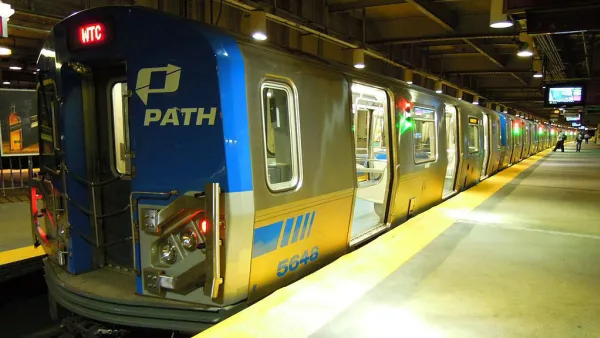
The Gateway project would include two new tunnels under the Hudson River to augment the existing two 105-year-old Amtrak tunnels which NJ Transit also uses for all trains going into New York. The project would also include constructing two new tracks between Newark and New York for a total of four tracks. Amtrak estimates the earliest the new tunnels could be in service would be 2030.
Read the full story: Corporation to Oversee New Hudson Rail Tunnel, With U.S. and Amtrak Financing Half
Amtrak Gateway Planning Is Coming Together
Initial planning steps toward replacement of the 105-year-old tunnels under the Hudson River between New Jersey and New York's Penn Station are underway, with New Jersey Transit, Amtrak, and the Port Authority of N.Y & N.J. all playing key roles.
Financing of Hudson River Rail Tunnels in Peril
A funding agreement between New York, New Jersey, and the U.S. DOT for one of the most important rail projects in the nation is in danger of collapsing because of the way the two states are financing their share of the $12.9 billion cost.
Northeast Rail Corridor Woes Extend Far Beyond Hudson River Tunnels
While Amtrak's century-old Hudson River rail tunnels may capture the public's attention, particularly when they are closed, infrastructure problems on the Northeast Corridor also plague the line from Rhode Island to Washington, D.C.

Planetizen Federal Action Tracker
A weekly monitor of how Trump’s orders and actions are impacting planners and planning in America.

Eastern Nebraska is running out of electricity
Data centers and electrification are straining eastern Nebraska’s grid, throttling economic development.

Washington state to charge fee to drivers with fuel-efficient cars
Revenue from the fee will go towards supporting the state’s highways.

Instead of building new housing, LA developers are turning mansions into mega-mansions
In the richest areas, the number of houses valued at $30 million with demolition permits has skyrocketed since 2018.

Illinois considers spending $1 billion in taxpayer money on data center
A quantum computing campus and data center are currently under construction in Chicago.

As development costs rise, Boston moves to lessen affordable housing requirements
The Boston Zoning Commission and the City Council still need to approve Boston Mayor Michelle Wu’s proposed changes

FREE Course: Walkable City 1: Why Walkability?
After describing his path towards focusing on walkability as the essence of good planning, Jeff Speck marches through his five principal reasons for making more walkable places.
Reinventing Malls: Planning Alchemy—Turning Gray Fields Into Gold
The course focuses on the opportunities and imperatives that shape reinvention of mall sites.

City of Charlotte
City of Rosemead
Rutgers University, Edward J. Bloustein School of Planning and Public Policy
University of Michigan School for Environment and Sustainability (SEAS)
Hunter College, City University of New York (CUNY)
The Architects Foundation
University District Partnership
City of Cambridge
The Pocatello Development Authority