At the heart of the financial and deadline challenges facing the $68 billion high-speed rail project are 36 miles of tunneling north of Los Angeles, according to Los Angeles Times analysis that includes interviews with experts on mega-projects.



"State officials say the tunnels will be finished by 2022 — along with 300 miles of track, dozens of bridges or viaducts, high-voltage electrical systems, a maintenance plant and as many as six stations," writes Ralph Vartabedian of the Los Angeles Times.
Vartabedian writes that his paper's analysis "indicates that the deadline and budget targets will almost certainly be missed — and that the state has underestimated the challenges ahead, particularly completing the tunneling on time." which he calls "the most ambitious tunneling project in the nation's history."
"It doesn't strike me as realistic," said James Monsees, one of the world's top tunneling experts and an author of the federal manual on highway tunneling. "[Earthquake] Faults are notorious for causing trouble."
The tunnel challenges are indeed formidable. The project "will require about 20 miles of tunnels under the San Gabriel Mountains between Burbank and Palmdale, involving either a single tunnel of 13.8 miles or a series of shorter tunnels."
The rail authority only asked permission last month to begin testing under the Angeles National Forest to build the tunnels, wrote Steve Scauzillo of the San Gabriel Valley Tribune on Sept. 25 in a detailed article about tunnel options.
In addition, "(a)s many as 16 additional miles of tunnels would stretch under the Tehachapi Mountains from Palmdale to Bakersfield," adds Vartabedian.
Three years ago Vartabedian wrote about the same engineering challenges - posted here.
Other experts chimed in on the other challenges facing nation's largest public works project.
...Bent Flyvbjerg, a University of Oxford business professor and a leading expert on megaproject risk, said the lagging schedule, litigation, growing costs and permit delays arising so early in construction are warning signs that even more delays and higher costs are coming.
"You can never make up an early cost increase," said Robert Bea, a member of the National Academy of Engineering and a pioneer in civil engineering risk analysis. "It just gets worse. I have never seen it go the other way in 60 years."
Do tunnel projects go bad? Just ask the citizens of Seattle where the world's largest boring machine, Big Bertha, has yet to renew boring the Alaskan Way Viaduct replacement tunnel since it broke down in December 2013. However, it was "on the move" last February and is now being repaired.
Notwithstanding the projects formidable challenges, there are those who believe in the project, wrote Steve Benen for MSNBC in January. Even retiring House Speaker John Boehner said rather unexpectedly two years ago that he’d like to see the United States become “a nation of builders” again.
FULL STORY: Special Report $68-billion California bullet train project likely to overshoot budget and deadline targets

Latest Hotbed of High Speed Rail Opposition: San Fernando Valley
Opposition, followed by legal action to the California High-Speed Rail project began in Northern California, spread to the Central Valley, and now has hit southern California, particularly in the San Fernando Valley of Los Angeles County.
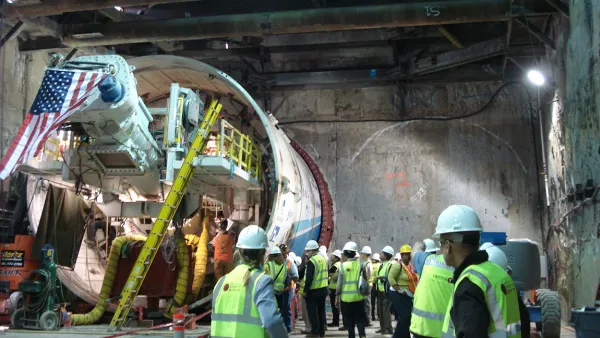
Seattle's Envy? San Francisco's Big Alma Outperforms Big Bertha
Big Alma is one of two boring machines used to tunnel under the streets of San Francisco to construct the new Central Subway to Chinatown. Big Bertha, Seattle's infamous tunnel borer, has been stalled since December. Big Alma emerged on June 11.
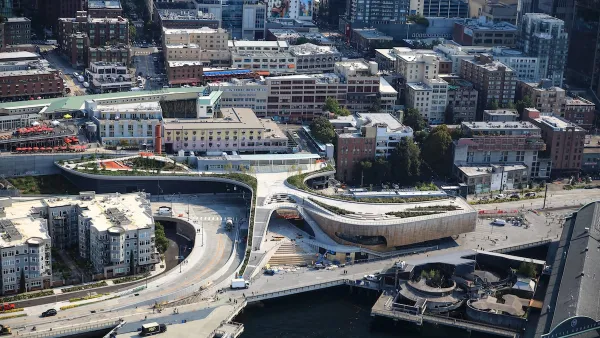
Seattle’s New Overlook Walk Offers Ample Park Space Near Pike Place Market
The elevated park and event space replaces part of the demolished Alaskan Way Viaduct, connecting the city’s famous Pike Place Market to the waterfront.

The state-sanctioned urbicide of Austin
People don’t kill cities. Freeways do.

US to reduce Colorado River water deliveries to Mexico
A new Colorado Treaty amendment reduces Mexico’s Colorado River water allocation by 250,000 acre feet.

New Jersey’s second-largest city bans standalone data centers
Jersey City will continue to allow co-location facilities, such as those meant for research institutions that store their own data.

Amtrak not solely to blame for New Jersey commuter rail's unreliability, report finds
A new study from the Garden State Initiative found that NJ Transit’s budget grew 20% across a 4 year period, but reliability declined significantly over the same period.

EPA erases limits on planet-warming pollution from power plants
Under Monday’s plan, power plants would still have some limits on how much mercury, arsenic and other contaminants they can emit.

Phoenix announces new on-demand transit service, more frequent RAPID buses
Both new services will launch in October, and are part of Phoenix's Project Effective Access Solutions for Easing Congestion.

FREE Course: Walkable City 1: Why Walkability?
After describing his path towards focusing on walkability as the essence of good planning, Jeff Speck marches through his five principal reasons for making more walkable places.
Reinventing Malls: Planning Alchemy—Turning Gray Fields Into Gold
The course focuses on the opportunities and imperatives that shape reinvention of mall sites.


Eagle County Government
Harvard University Graduate School of Design
Nashville Planning Department
The Architects Foundation
University of Cincinnati Online
The Pocatello Development Authority
The Urban Renewal Agency of the City of Pocatello
Journal of the American Planning Association