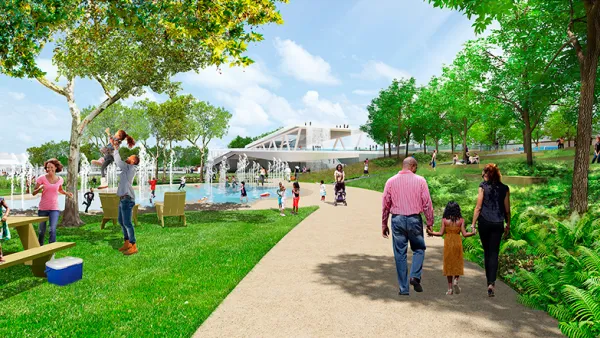
A proposal to design a park at the 11th Street Bridge between Capitol Hill and Historic Anacostia includes a through study of how the new park can connect two neighborhoods without leaving anyone behind.


"The group behind the plan to build a park on the old 11th Street Bridge is seriously committed to making sure the project is a net gain for the communities around it," reports Neil Flanagan.
The plan for the 11th Street Bridge Park includes "19 concrete recommendations for how to bring economic opportunities to the neighborhoods adjacent to the park without also bringing the negatives that neighborhoods often experience when they get wealthier."
Flanagan describes a few of the ideas contained in the proposal. "For example, they want to incubate small retail businesses on the bridge, and making the routes to the park more walkable, so people venture into Anacostia's retail strip." Also considered is the creation of a community land trust and how to place local businesses in any new buildings developed by the District in the area.
Read the full story: Plans are gelling for a park over the Anacostia. Here are ways to ensure it helps, not displaces, existing residents.

Can D.C. Build its Bridge Park Without Displacement?
The park's non-profit developer has engaged in a years-long community outreach process and invested over $60 million in community initiatives.
Philanthropy Fights Gentrification Around D.C.'s Planned Bridge Park
With lessons from high-profile urban revitalization in place, organizers and philanthropists are working to ensure the 11th Street Bridge Park doesn't push low-income residents out of surrounding neighborhoods.
Working to Ease Gentrification Around D.C.'s Ambitious 11th Street Bridge Project
From the beginning of the proposal for the new 11th Street Bridge between Anacostia and Capitol Hill, planners and designers have promised to prevent the displacement of residents living nearby the new amenities offered by the bridge and its park.

Planetizen Federal Action Tracker
A weekly monitor of how Trump’s orders and actions are impacting planners and planning in America.

California plans to bury El Niño’s downpour
If the state plays its cards right, it may be able to store a billion acre-feet of El Niño’s water in aquifers.

Chicago breaks ground on $3 billion megadevelopment
The new neighborhood, titled Foundry Park, will one day host 3,700 residences.

This road in NYC is infamously dangerous — and Mamdani can't fix it
New York City's Ocean Parkway is known for reckless driving, but the power to implement safety measures lies with the state rather than the city.

One of Denver’s busiest corridors to gain BRT
The project will span 18 miles and contain 74 bus rapid transit stations.

275,000 bus trips are at stake on Seattle's ballot
If passed, the Seattle Transit Measure would trigger a 0.3% sales tax and raise an average of $138 million per year to maintain and expand Seattle’s bus services.

FREE Course: Walkable City 1: Why Walkability?
After describing his path towards focusing on walkability as the essence of good planning, Jeff Speck marches through his five principal reasons for making more walkable places.
Reinventing Malls: Planning Alchemy—Turning Gray Fields Into Gold
The course focuses on the opportunities and imperatives that shape reinvention of mall sites.

City of Rosemead
Rutgers University, Edward J. Bloustein School of Planning and Public Policy
One Hundred Miles
Hunter College, City University of New York (CUNY)
The Architects Foundation
University of Cincinnati Online
City of Cambridge
Montrose County
The Pocatello Development Authority