Is a gentrified Venice Beach still Venice Beach? With median home prices topping $1.4 million, the area's eclectic characters can't afford to stay. Investors and the tech industry say the change is only natural.


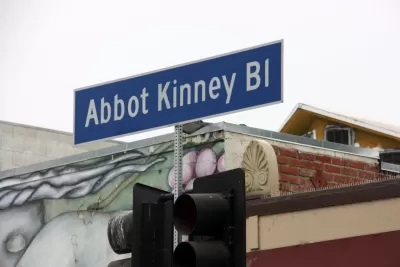
Venice Beach is on the path to becoming something very different. Some are now calling the area Silicon Beach. "As skyrocketing real estate prices push longtime residents out of this oceanside district of Los Angeles, corporate chains are replacing funky shops, and tech geeks are emerging as a dominant part of the scene."
Google and Snapchat stand out among a throng of start-ups and plentiful investment by moneyed interests. Median home prices are up from $832,000 to $1.4 million in the past five years alone. Abbot Kinney Boulevard, formerly a space for bohemian shops and eateries, has gone full yuppie. "In a stunner last month, a piece of commercial property on the boulevard sold for $44 million to a New York partnership [...] Jaws had also dropped when the same property sold for $20 million two years ago."
Venice's breakneck gentrification is pushing out the artists and musicians who defined the area for so many years. Some commentators call it natural, prime beachfront property finally coming into the value it should have had all along. Venice is now the top Airbnb spot in L.A.
If that's the case, the area's hippies and avant-garde artists will need to find somewhere else to call home. Or as one resident put it, "A lot of other people, they just disappear, dude."
Read the full story: How Snapchat tech titans are harshing the mellow in Venice Beach

Million-Dollar Homes Becoming Standard Fare Across Los Angeles
As households with means seek to escape crowded apartment buildings and take advantage of historically low mortgage rates, average home prices of over $1 million are proliferating across the LA region.

High Housing Costs Driving Down Transit Ridership in LA
When neighborhoods gentrify and displace lower-income residents, transit ridership suffers, new research shows.
Another L.A. Gentrification Story
New art galleries are moving into a neighborhood recently dubbed ‘Melrose Hill,’ prompting both derision and concern on the part of local residents.

Planetizen Federal Action Tracker
A weekly monitor of how Trump’s orders and actions are impacting planners and planning in America.

Amtrak, CN end decades-long dispute with eight-year agreement
The new operating agreement establishes an updated framework for the companies to work together, including processes to resolve disputes.

Judges permit Denver to divert 77,000 acre feet from the Colorado River for reservoir expansion
Overuse and climate change have caused the Colorado River’s water levels to plummet.

Boston has spent millions making the Green Line more accessible — and there’s no end in sight
While the city has invested millions into expanding and adding platforms to the Green Line to make it more accessible, new train cars set to arrive next year will be too tall for disabled passengers to board without raising the current platforms.

Idaho may see an 18% drop in federal surface transit funding — the largest estimated cut in the US
Transit systems in rural communities are much more reliant on federal funding to provide their services.

How ‘post-disaster gentrification’ alters neighborhoods after natural calamities
After hurricanes, fires or other calamities, the original residents of a community are often replaced by younger, wealthier residents.

FREE Course: Walkable City 1: Why Walkability?
After describing his path towards focusing on walkability as the essence of good planning, Jeff Speck marches through his five principal reasons for making more walkable places.
Reinventing Malls: Planning Alchemy—Turning Gray Fields Into Gold
The course focuses on the opportunities and imperatives that shape reinvention of mall sites.

City of Wisconsin Rapids
Harvard University Graduate School of Design
KFH Group Inc.
The Architects Foundation
University of Cincinnati Online
The Pocatello Development Authority
The Urban Renewal Agency of the City of Pocatello