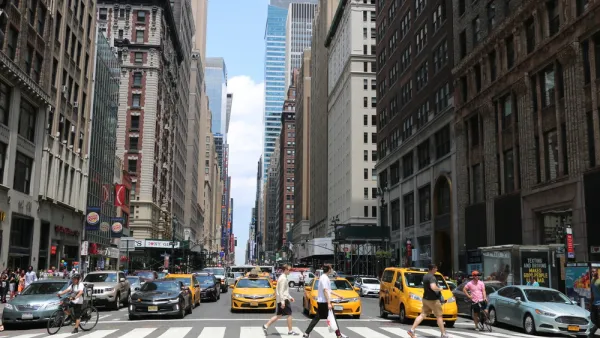
Exotic street performers in the plaza have caused Mayor Bill de Blasio to reconsider his initial opposition to street plazas. Unlike his police commissioner and the governor, de Blasio has yet to make a decision on the removal of Times Square plaza.


Following through with a statements he made as a mayoral candidate in 2013 that he would consider opening Times Square and Herald Square to auto traffic, "Mayor Bill de Blasio said on Thursday that he would consider removing the pedestrian plazas from Times Square in a bid to restore order in the crowded streets of the Manhattan crossroads," writes Michael M. Grynbaum for The New York Times.
The move, which the mayor described as one of several options to be considered by a task force of New York City officials, would undo a signature accomplishment of Mr. de Blasio’s predecessor, Mayor Michael R. Bloomberg, whose decision to close part of Times Square to vehicular traffic has been hailed as an influential innovation in urban design.
"Mayor Bill de Blasio said on Tuesday (Aug 18) that he sees the women (called Desnudas - video) parading around Times Square covered in little but body paint not as creative artists, but as pushy panhandlers whose efforts to separate tourists from their money should be regulated," writes Patrick McGeehan.
De Blasio "announced a task force to consider ideas on how to better prevent activities that the city deems illegal or harmful to the area’s quality of life," writes Grynbaum. His police commissioner, William J. Bratton, who will co-chair the task force, was ready "to just dig the whole damn thing up and put it back the way it was,” he said in a radio interview.
Gov. Andrew M. Cuomo, who has often been at odds with the mayor, has already come out for the removal of the plazas.
Grynbaum goes on to write about the reaction to their possible removal in social media.
FULL STORY: Mayor de Blasio Raises Prospect of Removing Times Square Pedestrian Plazas

The Battle for Times Square—Why It Matters, Even Outside New York
The piece begins not in New York but three thousand miles west in Seattle with Janette Sadik-Khan explaining how she triumphed over auto interests by taking back precious road space and returning it to the people in the form of plazas and bike lanes.
Praise for Gov. Andrew Cuomo from New York Times on Cordon Pricing
Thanks to the governor's support, there is reason for optimism that a plan to charge motorists entering Manhattan below 60th St. and toll the East River bridges will have a better outcome than Mayor Michael Bloomberg's plan did in April 2008.
High-Rise Approval Secures $220 Million for Grand Central Terminal Improvements
In exchange for the approval to build One Vanderbilt, a 63-story office tower adjacent to Grand Central Terminal, the developer will give the MTA $220 million for upgrades to entrances of the Metro-North Railroad and the terminal's subway entrances.

The state-sanctioned urbicide of Austin
People don’t kill cities. Freeways do.

US to reduce Colorado River water deliveries to Mexico
A new Colorado Treaty amendment reduces Mexico’s Colorado River water allocation by 250,000 acre feet.

New Jersey’s second-largest city bans standalone data centers
Jersey City will continue to allow co-location facilities, such as those meant for research institutions that store their own data.

Amtrak not solely to blame for New Jersey commuter rail's unreliability, report finds
A new study from the Garden State Initiative found that NJ Transit’s budget grew 20% across a 4 year period, but reliability declined significantly over the same period.

EPA erases limits on planet-warming pollution from power plants
Under Monday’s plan, power plants would still have some limits on how much mercury, arsenic and other contaminants they can emit.

Phoenix announces new on-demand transit service, more frequent RAPID buses
Both new services will launch in October, and are part of Phoenix's Project Effective Access Solutions for Easing Congestion.

FREE Course: Walkable City 1: Why Walkability?
After describing his path towards focusing on walkability as the essence of good planning, Jeff Speck marches through his five principal reasons for making more walkable places.
Reinventing Malls: Planning Alchemy—Turning Gray Fields Into Gold
The course focuses on the opportunities and imperatives that shape reinvention of mall sites.

Eagle County Government
Harvard University Graduate School of Design
Nashville Planning Department
The Architects Foundation
University of Cincinnati Online
The Pocatello Development Authority
The Urban Renewal Agency of the City of Pocatello
Journal of the American Planning Association